Do Blinkers and Headgear Actually Help?
Across the data, horses in headgear win less often than horses without it — which makes "first-time blinkers" a flag to read, not a green light to back.
First-time blinkers is one of the most-backed angles in racing. The story is easy to tell: the trainer has found the missing piece, the horse will finally concentrate, the penny drops, the price is generous because the form looks ordinary. It is a satisfying narrative, and the crowd pays for it.
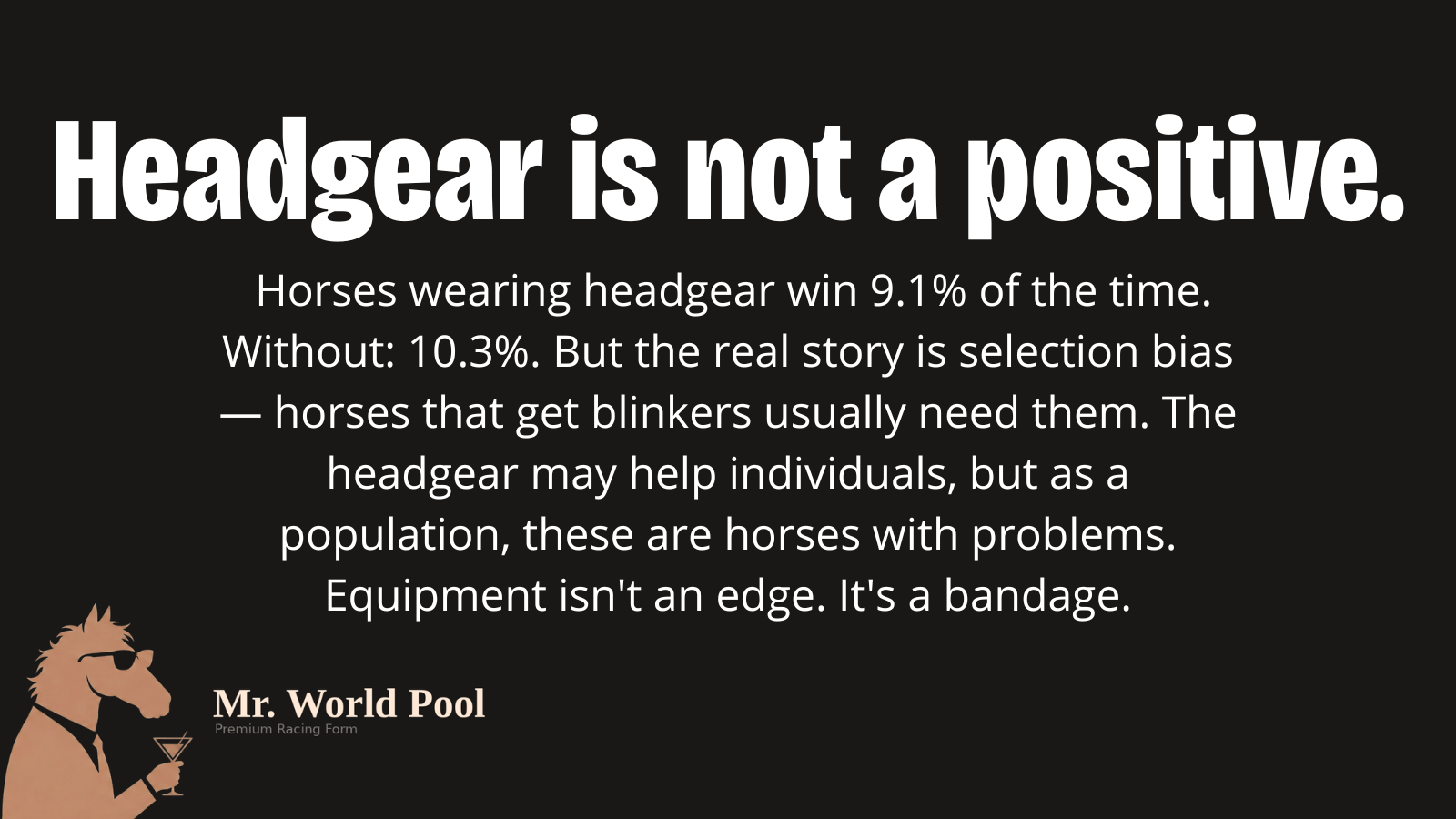
The aggregate numbers do not support the story. Horses running in headgear — blinkers, visor, cheekpieces or a hood — win about 9.1% of the time. Horses running without any headgear win about 10.3%. The kit is associated with a lower win rate, not a higher one. That gap is small in percentage points and large in what it does to a popular betting habit.
The Headline Number
| Runner | Win rate |
|---|---|
| In headgear (blinkers, visor, cheekpieces, hood) | ~9.1% |
| No headgear | ~10.3% |
Read it plainly before reaching for an explanation. A horse wearing gear is, on average, slightly less likely to win than one without. This is not a knockout difference, and it is not a reason to lay every headgear runner. But it is the opposite of the edge most punters assume they are getting when they see "blinkers first time" in the racecard.
Why the Equipment Reads as a Flag
Here is where fact becomes hypothesis, and it is worth keeping the two apart. The data is the win-rate gap above. The why is a guess — a reasonable one, but a guess.
The reading I lean on is not that blinkers slow a horse down. It is that horses which need blinkers tend to have a problem, and the equipment rarely fixes the problem. A hood for a fizzy, anxious type, cheekpieces for one that won't pull out and finish, blinkers for a horse that downs tools in front — every one of those is a trainer quietly telling you something about the animal. The gear is the acknowledgement, not the cure.
If that is right, the headgear isn't causing the lower strike rate. It is marking the kind of horse that wins a bit less often anyway. The equipment is a symptom of a flaw, and on average the flaw outweighs whatever the kit recovers. That mechanism is a hypothesis. The win-rate gap is the fact, and the fact is what you can act on.
First-Time Blinkers Is Information, Not a Signal
So treat the gear change as data about the horse, the same way you'd treat a class drop or a jockey switch — one input, not a verdict.
A first-time-blinkers runner is a horse whose connections have decided the previous version wasn't working. That can cut either way. Sometimes the gear genuinely sharpens a talented but unfocused type, and you get the eye-catching improver. Often it's a yard trying the last lever on a horse that has been telling you, run after run, that it doesn't want to win. The aggregate says the second case is common enough to drag the whole group below the no-headgear baseline.
The practical move is to stop treating the gear change as a reason in itself and start asking why this trainer is reaching for it now:
- Is the gear paired with other positives? A class drop, a return to a winning trip, a jockey upgrade and first-time blinkers stacked together is a confident entry. Blinkers alone, after a string of flat efforts, often reads as a yard out of ideas.
- Does this trainer make the move pay? Some yards have a genuine record with first-time headgear; most don't beat the average. This is exactly the kind of situational split covered in our piece on reading trainer statistics — grade the situation, not the gear.
- What is the horse's actual problem? Gear that addresses a real, fixable quirk is different from gear thrown at a horse that simply isn't fast enough. The racecard comments and the run-style usually tell you which.
How to Read Headgear on a Card
None of this means headgear is a reason to oppose a horse. A short-priced, well-handicapped runner that happens to wear cheekpieces is still a short-priced, well-handicapped runner. The point is narrower: the gear is not, on its own, a plus, and the market frequently prices it as one.
That mispricing is the whole opportunity. If the crowd shortens a first-time-blinkers horse because the angle "always wins," and the data says the angle group actually underperforms, the horses to be sceptical of are the ones whose price has already been bid up on the gear alone. Knowing where the equipment sits on a racecard — and refusing to add a point for it that isn't there — is a small, repeatable discipline.
The summary is blunt. Headgear is associated with winning less, not more. First-time blinkers is a popular bet that the aggregate doesn't justify. Read the gear as the trainer's confession about the horse, weigh it with everything else on the card, and never let it stand in for a reason.
See the gear in context. MWP puts headgear, trip, class, the draw and the rating side by side on every runner, so you can judge whether a first-time-blinkers move is meant or desperate. Open a real racecard and read it for yourself, or learn to grade the move in Do Your Homework.
Related: Reading trainer statistics · How to read a racecard