Draw Bias and Ground Loss: When the Gate Decides the Race
Where a horse starts can be worth several lengths before it has done anything.
Where a horse starts can be worth several lengths before it has done anything. The draw shapes early position, traffic, and the ground a horse travels. Read it well and you'll fade favourites the market overrates and catch outsiders it ignores.
The Draw Is Never Neutral — But It's Not Simple Either
An inside draw saves ground but can trap a horse behind a wall of speed. An outside draw avoids early traffic but forces a wider, longer trip. Which one wins out depends on track geometry, distance, surface, field size and running style, never on the gate number alone.
The hard data makes the stakes concrete. At Sha Tin over 1200m, gate 1 wins about 11.5% (n=1,665) while gate 13 wins about 4.6% (n=566). Same track, same trip, more than double the win rate for the rail gate. A fancied favourite drawn 13 there is fighting the draw before the gates open; an overlooked horse drawn 1 has been handed an edge the market is slow to price.
The Most Important Number: The Run to the First Turn
The single factor that most often drives how much the draw matters is the distance from the gate to the first bend.
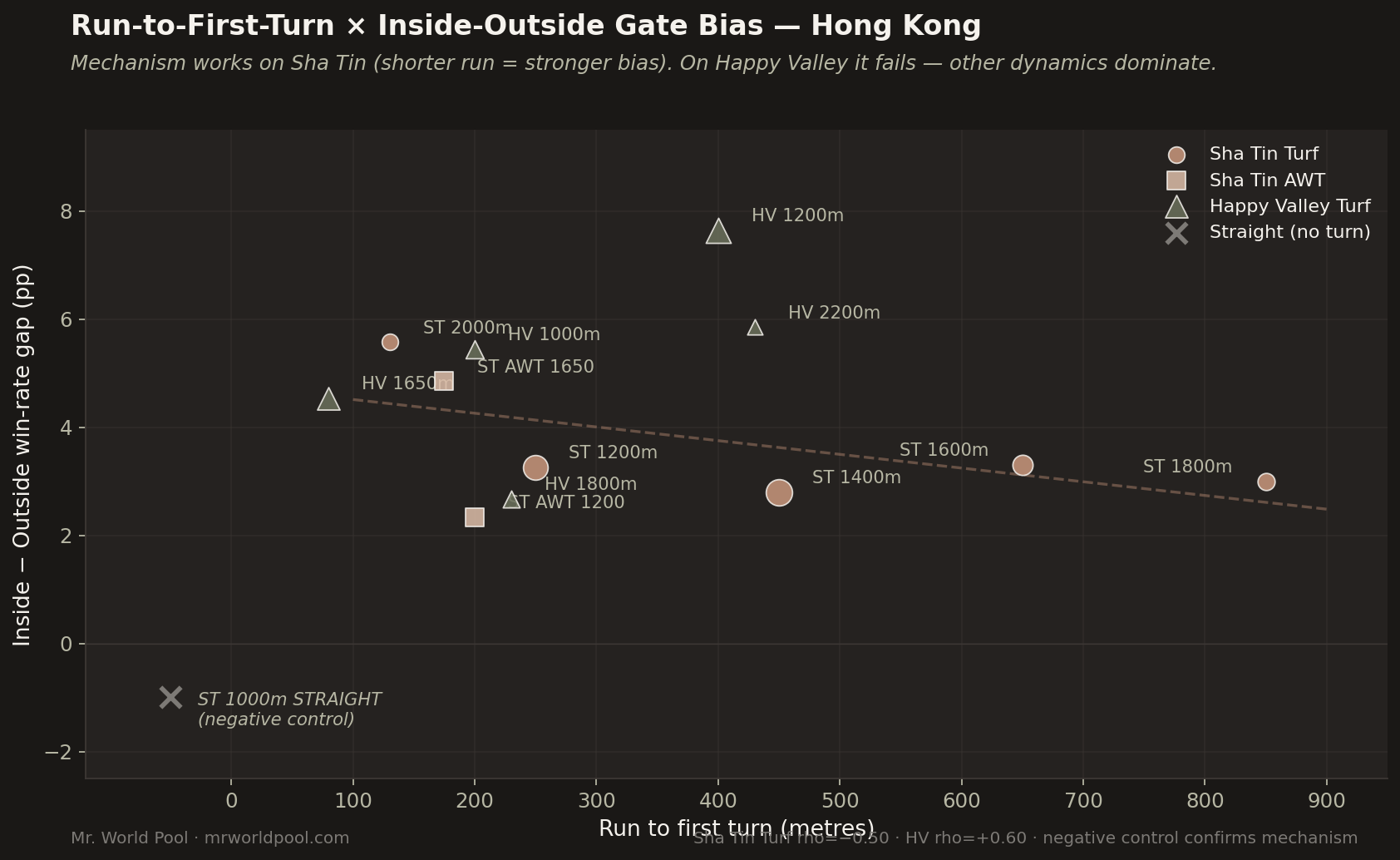
- A short run-up tends to make the draw enormous. When the field meets the turn almost at once, a wide horse has less room to cross over — the usual explanation is that it either burns energy getting across or gets shuffled back and stuck wide. Sha Tin's 1200m, with only a short dash to the bend, is the textbook case.
- A long run-up tends to neutralise the draw. Give the field several hundred metres of straight first and the bias usually fades, the idea being that everyone has time to find position on merit. A 1200m course with a long, sweeping run before its only turn will often barely show a draw bias at all.
- Straight courses remove the turn entirely. On a straight race the draw stops being about ground saved and becomes about which strip of track is running best that day.
Before you bet a turning race, ask one question: how far to the first bend? A long answer means downgrade the draw. A short answer means it may be the most important factor in the race.
Ground Loss: Lengths the Result Line Never Mentions
A horse taken wide runs a physically longer race. The rule of thumb is roughly one length lost per path off the rail, per turn — so about two lengths for a four-wide trip, four to five for a six-wide trip over two bends.
This changes how you read a result. A horse beaten a length after racing three-wide throughout didn't run a length worse than the winner — it ran further and lost a length doing it. That's an upgrade hiding in a plain result line. "Raced wide" is a ground-loss flag, and paired with a figure a few points below the horse's norm, it's one of the cleanest excuses in handicapping.
Long-Term Bias vs the Daily Version
Gate statistics capture the structural bias of a course and distance. The daily bias is different. Weather, rail position and ground prep can make a track favour inside speed one afternoon and outside closers the next. Watch the first few races: if every winner led from an inside draw, you have a live bias to apply to the rest of the card.
Two caveats keep you out of trouble. First, sample size. A gate with 40 starts behind it is a hint; one with 400 is a fact. Second, gate edges are direction-independent: a good gate lifts whoever draws it, and it's worth most when the horse is one the market hasn't noticed.
The draw won't win you a race on its own. But it quietly decides plenty of them, and the market is slow to price it. That's the opening.
MWP computes how every gate has actually performed at each course and distance, with the sample size attached. Pull up a real racecard and read the draw for yourself, or learn to use the gate stats in Do Your Homework, chapter 7.
Related: Pace handicapping · Trip handicapping: the horses the result hides