French Racing Form: Stamina Country, and Where the Rules Break
Half of all French races are run over 1800 metres or more — France breeds stayers and writes races for them, which makes it a different handicapping game from the gates back.
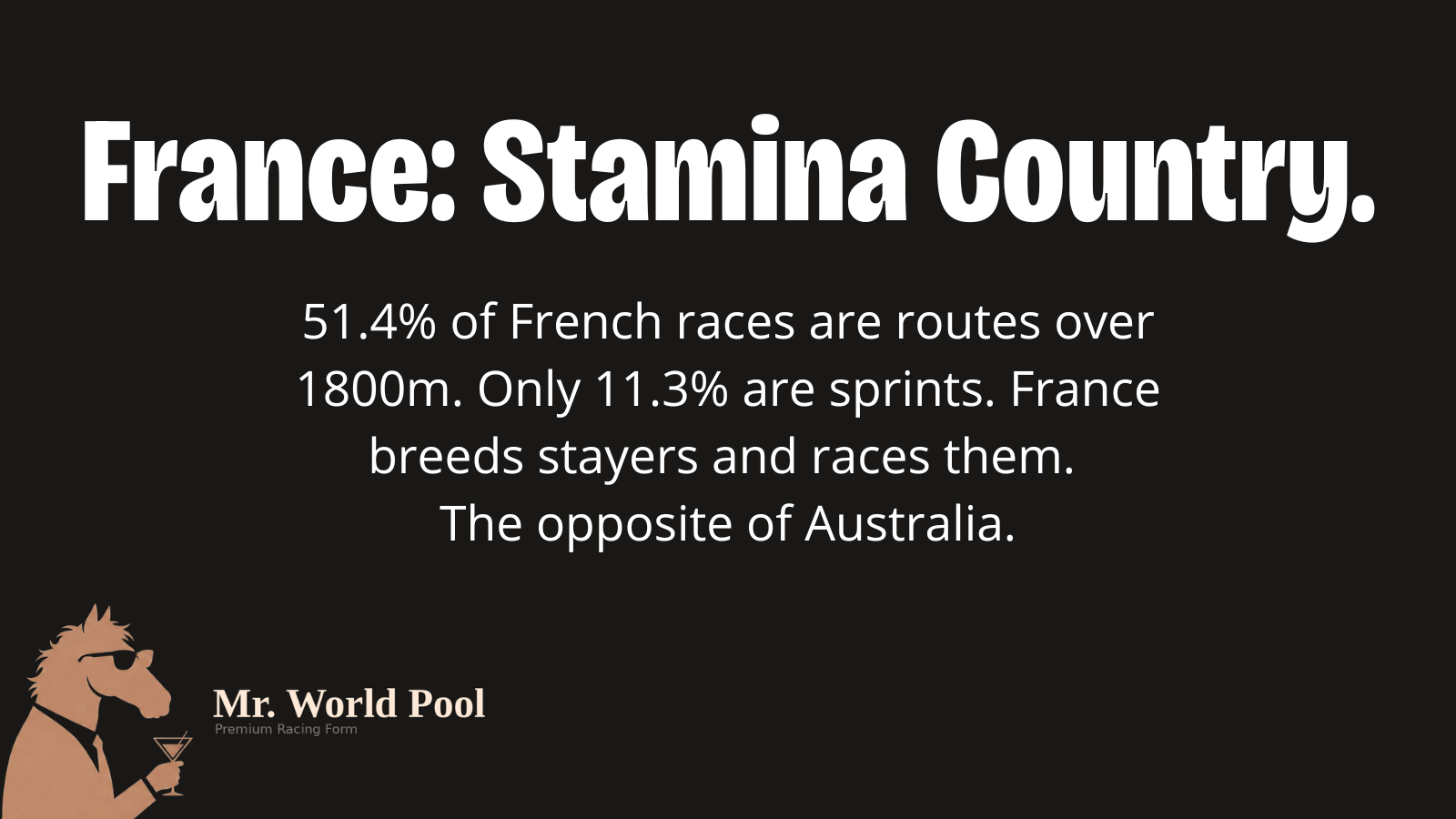
Start with the number that defines the country: 51.4% of French races are 1800m or longer, and sprints make up only about 11.3%. France is the exact mirror of Australia: where Australia's programme is built around speed, France's is built around stamina. Why that is — breeding, tradition, the kind of racing the country has chosen to write — matters less than the measured shape of the card. Almost everything that follows about reading French form comes back to this one fact.
A Programme Built for Stayers
When more than half a card is run at a mile and an eighth or further, the everyday French horse is a different animal from the everyday Australian one. The sprinter is the exception here, not the rule. That shapes the breeding, the training patterns, and the way races are run.
For a handicapper, the first consequence is about pace. The usual reading is that longer races give a field more time to sort itself out: the early scramble for position that decides a 1000m dash should matter less over 2400m, where a horse can lose three lengths at the start and still win. Whatever the mechanism, the front-running edge that dominates sprint-heavy jurisdictions tends to be diluted where the programme is built around route trips.
This is why you cannot port an Australian or an Irish reading of a card straight onto a French one. The base rates are different because the race distances are different. Count the front-runners by all means, but know that over a French route trip the lead is worth less than your instinct, trained on shorter racing, will tell you.
Where the Front-End Rule Breaks
Here is the part most punters get wrong, and it is the single most useful thing to know about the country.
On French all-weather, closers win about 19.2% of the time and pressers about 19.4%, essentially level. Nowhere else we track do closers run dead level with the horses sitting on or near the speed. The front-end bias that shows up almost everywhere, the reason "count the front-runners" is good advice in most jurisdictions, does not hold here.
| Running style (French AW) | Win rate |
|---|---|
| Pressers | ~19.4% |
| Closers | ~19.2% |
Read that table next to almost any other surface we cover and the difference jumps out. In most places the horse ridden to lead or track the lead wins materially more often than the one dropped out the back. On French all-weather, the held-up horse converts at the same clip. The closing run that gets buried in the pack elsewhere actually gets home here.
The practical rule: know which market you are in before you count the front-runners. A pace read that is correct at Meydan or in Ireland can be exactly backwards in France. Don't fade a French closer on reputation, and don't overrate a French front-runner just because front-runners usually win.
The Trainer You Cannot Ignore
If you are going to learn one French connection before anything else, learn this one.
Jean-Claude Rouget, over the last five years: 877 runners, 228 winners, about 26%. That is the most dominant trainer in French flat racing, and it is not close. Roughly one in four of his runners wins.
A 26% strike rate over a sample that size is not a hot streak; it is a structural fact about French racing. It does not mean every Rouget runner is a bet. The market knows exactly who he is, and prices accordingly. What it means is that a Rouget runner sets a high baseline you have to argue against, not for. When you see the name, your default is respect; your job is to decide whether the price has gone too far the other way.
That is the right way to use any trainer number. The strike rate tells you where the floor is. The odds tell you whether there is anything left to bet. For more on reading connections without paying for the obvious, see trainer statistics and betting.
How to Read a French Card
Three habits, in order:
- Respect the trip. Half the programme is a route. Pace and position matter less than they do in sprint country, so weight your read toward stamina, class and the run-style fit for the distance.
- Check the surface before the pace. On the all-weather especially, closers and pressers are level. Don't apply a front-end assumption you imported from another jurisdiction.
- Use the strongest trainers as a baseline, not a tip. Rouget at 26% is a starting point for the price argument, never the end of it.
The craft is the same everywhere. What changes country to country is the base rates: the programme shape, the surface biases, the strike rates. France differs from most of the world on all three. Learn the local numbers first, then handicap normally.
MWP reads the French form for you: normalised ratings, gate stats, pace and trip notes on every runner, with the surface and trip biases already in the read. Open a real racecard and check the pace for yourself, or learn the method from the ground up in our free course, Do Your Homework.
Related: Pace handicapping · Trainer statistics and betting