Irish Racing Form: Why the Front-Runners Win
On Irish turf, horses that lead win 12.9% of the time and horses that close win 7.6% — and the softer the ground, the wider that gap gets.
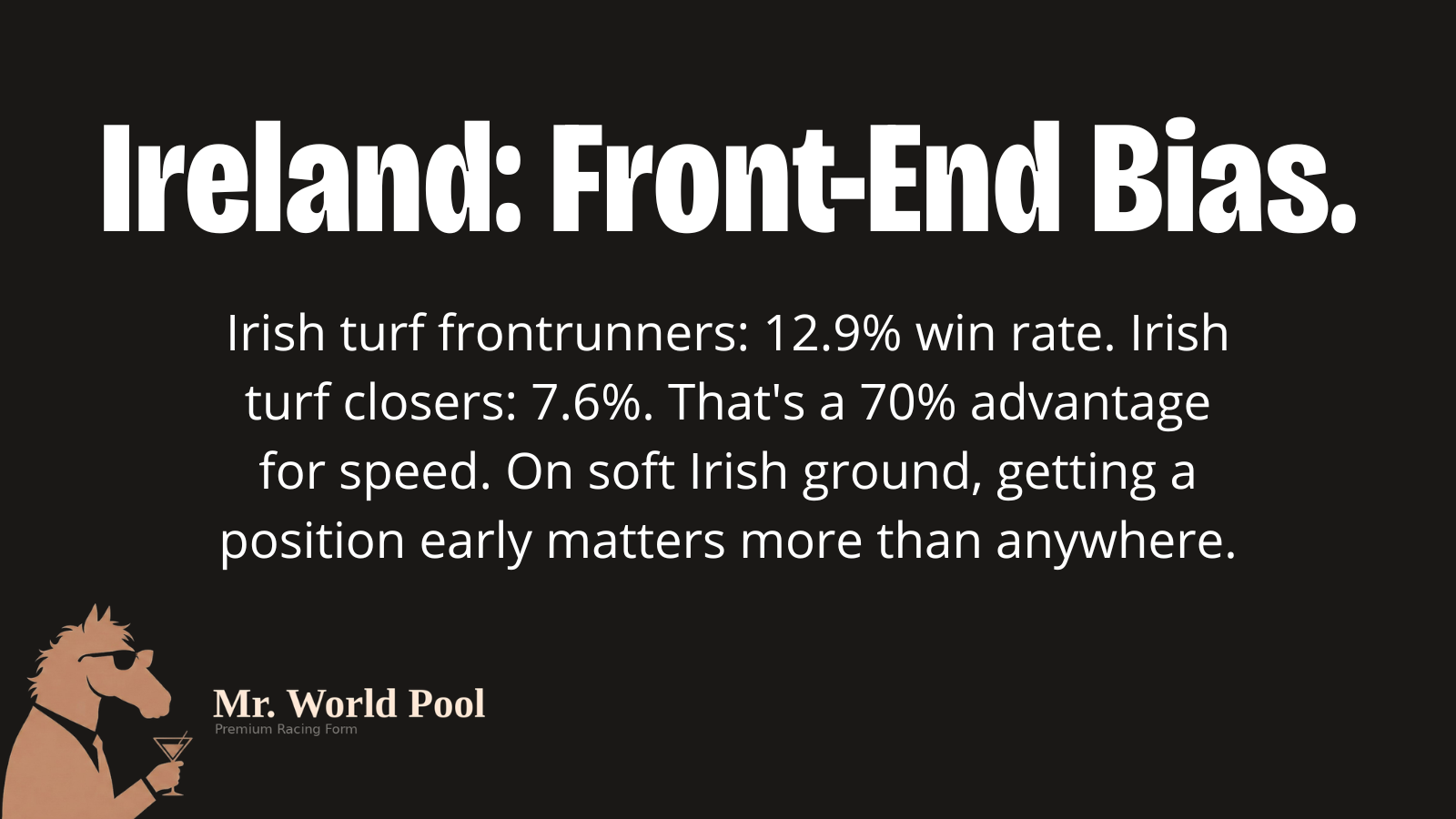
Irish turf front-runners win about 12.9% of their races. Closers win about 7.6%. That is a 70% advantage for the horse that gets out and rolls, and it is the single most useful fact you can carry into an Irish card. The romance of the swooper coming from last to first is real, it just doesn't pay. In Ireland, position is the edge.
Why the front end might win here
Two explanations are usually offered for the gap. Treat them as plausible stories, not proven mechanisms — the pattern is what you adjust for, and it holds whether or not the reasons below are the right ones.
First, the ground. Irish turf is soft for large parts of the season — proper, holding, energy-sapping ground, not the quick summer surfaces you get elsewhere. The usual argument is that soft ground punishes any horse giving away position: the leader gets first run on the better strip of grass, dictates the gallop, and only has to be collared once, while the closer has to make up lengths through the part of the track that has already been churned up, into ground that takes the sting out of every stride. On that view the mud slows the chase down more than it slows the leader. It is a reasonable story, and it fits the going split, but it is not something the data here proves.
Second, the gallops may be honest more often than not. Smaller fields and a high proportion of front-running tactics could mean fewer races collapse into a sprint off a crawl. If the pace is genuine, a closer has to be physically superior to win, not just better placed, and the horse on the lead only has to hold what it already has.
The numbers
| Running style | Approx. win rate on Irish turf |
|---|---|
| Front-runner / on-pace | ~12.9% |
| Held-up / closer | ~7.6% |
Read that as a structural bias, not a betting system. It does not mean every leader is a play, or every closer is a lay. It means that when you are choosing between two horses you rate closely, the one likely to be on or near the lead has the run of the race in its favour, and the one that needs everything to fall right is fighting the surface as well as the field.
The softer the going, the more this matters: that part is in the data, not a guess. On a quick summer card at the Curragh the gap narrows. On a heavy day at a galloping track in November, the front-running bias looks about as strong as you'll find anywhere. Check the going before you trust a hold-up horse.
How to use it on a card
Start by working out who leads. Read each horse's recent runs for where it raced — prominent, mid-division, held up — and find the one or two that want to be in front. A single uncontested front-runner on soft Irish ground is one of the better situations in the game, on the theory that nothing is going to soften it up for the closers behind.
Then sanity-check the closers. A strong-finishing horse can absolutely win, but it needs a fast, contested pace to run at and enough class to overcome the ground. If the race looks like it will be run at a sensible tempo and the going is soft, downgrade the swooper. The track is doing the leader's work for it.
This is pace handicapping, and it travels. The same logic that flags the lone-speed horse in Ireland flags it at Sha Tin and Meydan too. Ireland just gives you a cleaner version because the ground does so much of the talking.
The jockey-booking signal
There is a second layer the form will give you for free, and it is loudest at the top of the riding ranks. A travelling star rarely crosses the Irish Sea to ride work or pick up spare mounts; the plausible read is that they are flown in for horses someone expects to win.
So the booking itself is probably information. When a yard puts a top international jockey up on a single runner on an Irish card, the natural inference is that it thinks this is the day and this is the horse. The market sees the name and shortens the price, so the booking is rarely a value play on its own. But as a read on intent, a marquee booking on an Irish runner is about as loud a signal as the form will give you.
The short version
On Irish turf, leaders beat closers by a wide margin, and soft ground widens it. Find the pace, respect it, and treat the late-running horse as the one that needs help rather than the one that provides the drama. Then read who is riding — because in Ireland more than most places, who they flew in to ride tells you who they fancy.
MWP reads the Irish form for you: normalised ratings, pace and trip notes, and the jockey-booking signal on every runner. Open a real racecard and map the pace yourself, or learn the method from the ground up in Do Your Homework.
Related: Pace handicapping · Do jockeys matter?