What Age Do Racehorses Peak? What the Ratings Say
The market is fixated on the three-year-old. In our ratings, the average horse is still improving at five — and the "past it at six" discount is one of the quieter mispricings in the game.
Ask most punters when a racehorse is at its best and you'll hear "three." The Classics are run at three, the sales hype is loudest at three, and the romance of the unexposed colt is a three-year-old story. The ratings tell a calmer, later tale.
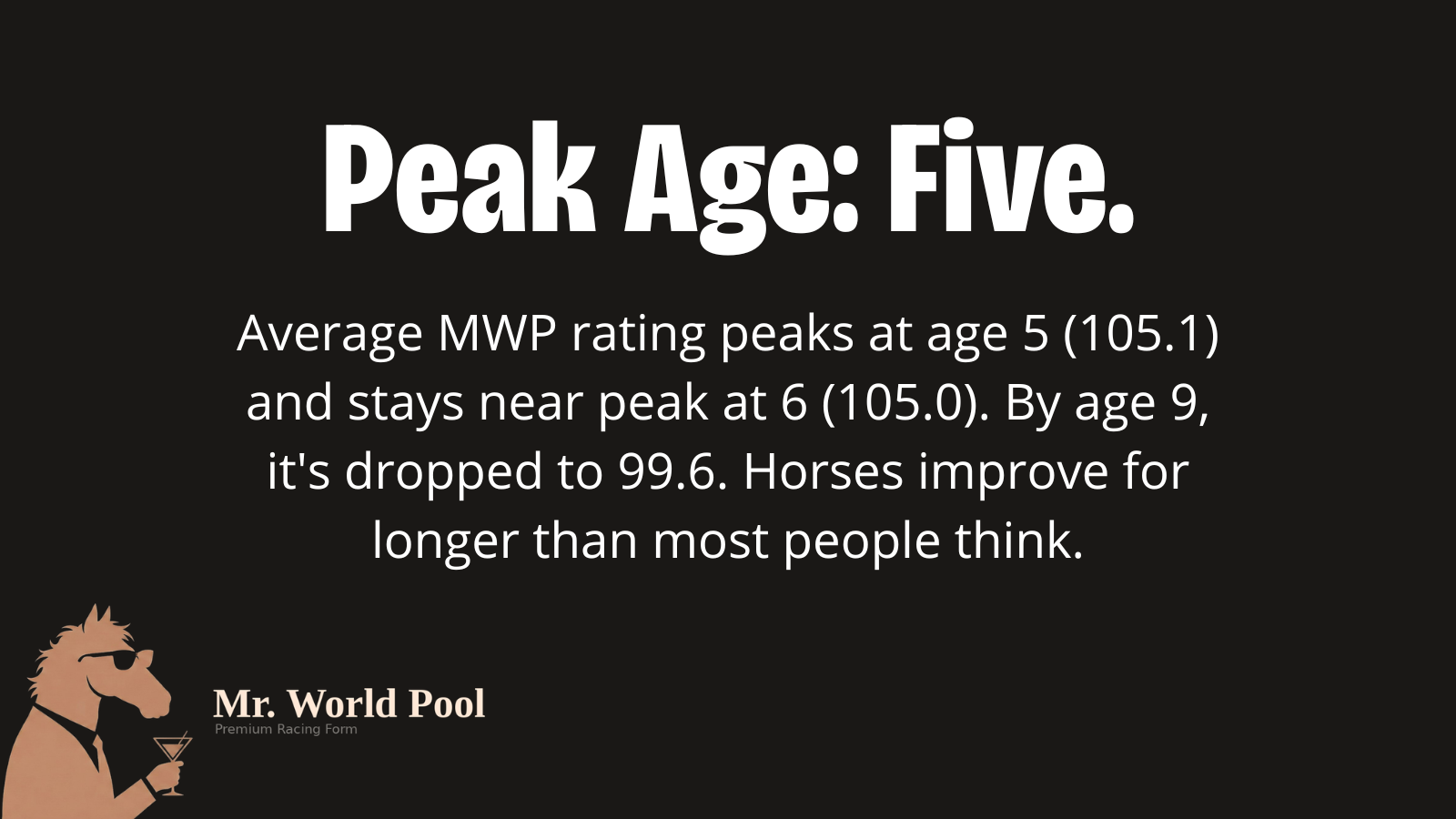
On the MWP rating scale, average performance peaks around age five, holds at six, and is still strong at seven. Horses improve for longer than the market's fixation on the Classic generation suggests. The gap between where the crowd thinks the peak is and where the numbers put it is a structural one — and it tends to leave the sound older horse underrated.
What the rating curve actually shows
To be precise about the claim: in our data, average ratings peak around five. That is a descriptive fact about a population, not a law about any individual horse. Some sprinters are fully wound up at three and decline early; some staying types don't show their best until six or seven. The curve is an average, and averages hide a lot of spread.
But the shape is the useful part. The improvement from three to five is real, the plateau at five and six is real, and the decline after seven is gentler than the betting public treats it.
| Age | Where the average rating sits |
|---|---|
| 3 | Improving, not yet peak |
| 4 | Close to peak |
| 5 | Peak (in our data) |
| 6 | Holds near peak |
| 7 | Still strong |
| 8+ | Gradual decline |
The "past it at six" discount is the mispricing. A sound six-year-old with a settled profile is often a better bet than the market price implies, because the crowd marks him down for age before the form says to.
Why the peak might come late
The data is the peak shape. The reasons are hypotheses — plausible stories that fit the curve without proving the mechanism.
The usual explanation is physical maturity. A thoroughbred is still filling out its frame at three and four; bone, muscle and the cardiovascular engine are likely still developing toward five. On that view the three-year-old isn't peaking, he's racing against older horses while still a work in progress, which is exactly why the weight-for-age scale exists to give him a pull.
A second story is selection and soundness. Horses still racing well at six and seven are, by definition, the ones that stayed sound and kept their form; the fragile and the limited have already dropped out of the population. So part of the late plateau may be survivorship rather than continued improvement. Both can be true at once, and neither changes how you'd use the curve: you adjust for the pattern, not the explanation.
The long-layoff penalty
Age is one half of the freshness question. Time off the track is the other, and here the data is blunt.
A horse returning from a year or more off the track wins well below the rough 10% baseline a runner posts in a typical field. The chance falls off more than the comeback story suggests, and the market, which loves a comeback, tends not to dock the returner enough. The longer the absence, the more the price flatters the horse relative to its real chance first time back.
This is worth separating from a normal break. A few months off is rarely the problem in itself; a fit, well-prepped horse off a routine layoff can run a big race fresh. It's the genuine year-plus returner the numbers punish, and the one the crowd most wants to forgive.
The comeback cycle
There's a piece of handicapping lore worth knowing here, and it's worth flagging as exactly that: a rule of thumb, not a measured curve from our data.
The lore goes: the first run off a long layoff knocks the rust off, the second builds fitness, and the third start is often the one. The market tends to price the comeback from run one, backing the big name on reputation the moment it reappears. The fitness curve, if the lore holds, argues for patience: let the horse blow away the cobwebs on someone else's money, and take an interest when the engine is properly running again.
Treat that as a framework for where to look, not a guarantee. Pair it with what you can actually see: a returner whose trainer is a proven first-up performer is a different proposition from one who needs every run.
The short version
In our data the average horse peaks around five, holds at six, and is still strong at seven, so the "young horse improving, old horse declining" instinct is wrong by a couple of years in each direction. The year-plus returner wins well below the field's baseline, and the market doesn't dock it enough. Read age and freshness together, give the sound older horse its due, and be patient with the comeback.
MWP normalises every horse's rating across age, surface and country, so you can see whether a five-year-old is genuinely at his peak or a returner is running on reputation. Open a real racecard and read the form yourself, or learn the method from the ground up in Do Your Homework.
Related: Ratings and speed figures explained · Trip handicapping