Australian Racing Form: Betting the Sprint Capital
More than half of all Australian races are sprints — so betting the form here means betting speed, gate, and early position before anything else.
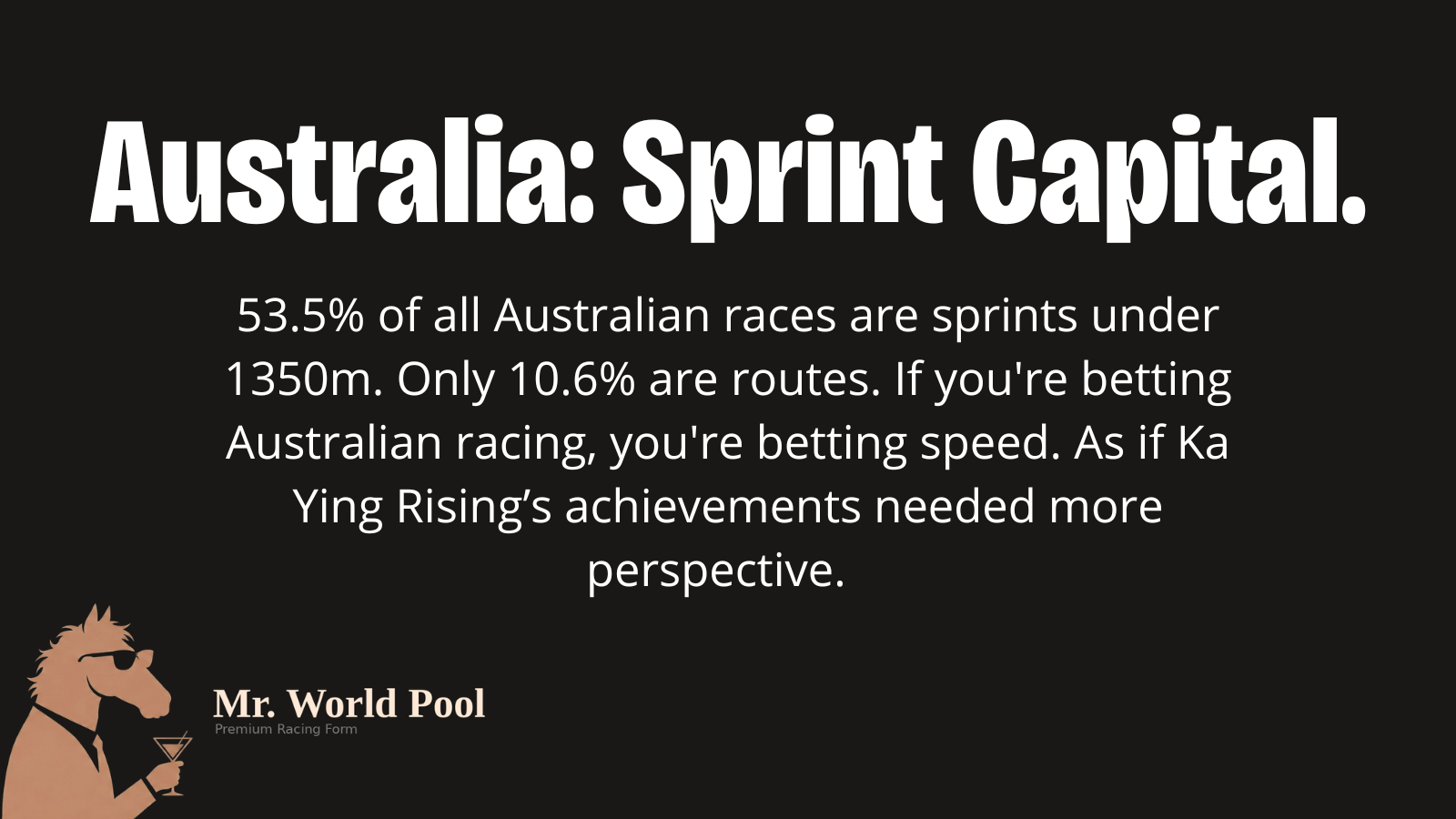
Start with the number that defines the whole jurisdiction: 53.5% of Australian races are sprints, and only about one in ten is a route of 1800m or more. No other major racing country is shaped like this. Australia is the sprint capital, and if you want to read the form here, you read it for speed first.
A Programme Built for Speed
In Britain, France or Hong Kong you handicap a broad spread of distances, and stamina is a live question in a large share of races. In Australia it usually isn't. With more than half the card run at sprint trips and routes a rarity, the form questions that matter most are the ones that decide short races: how fast does this horse break, can it hold a forward position, and what does the draw do to that plan.
That changes where you spend your time. Pedigree-for-stamina, late-closing sectionals over a mile and a half, the slow-burn staying type — those are minority concerns here. Gate speed and early position are the majority concern. The programme tells you what to study.
Front-Runners Carry an Edge, and It Travels Across Surfaces
The bias toward speed shows up in the win rates by running style. Front-runners win roughly 14.5% on turf and 13.9% on dirt, while closers sit around 10 to 11% on both surfaces. The leader's premium is real, and the striking thing is how little it changes when you switch the ground under their feet.
| Running style | Turf win rate | Dirt win rate |
|---|---|---|
| Front-runner | ~14.5% | ~13.9% |
| Closer | ~10–11% | ~10–11% |
That same-style-different-surface stability matters because it suggests the edge isn't a quirk of one surface. The speed premium looks structural rather than ground-dependent. A horse that wants the lead and can get it is advantaged whether it's on turf or dirt, and the gap over the closer is consistent enough that you can lean on it.
This is the single most useful frame for an Australian card: find the likely leader, then ask whether the draw and the pace let it do its job. One genuine front-runner with a clean run to the first bend is a different proposition to one of four speed horses all drawn to fight for the same ground. The mechanics of that are the same everywhere; they just come up more often here. The full method is in pace handicapping.
Favourites Win a Lot — Which Cuts Both Ways
Australian favourites win about 35% of the time, among the highest strike rates of any major market. For comparison, Britain and Germany sit around 34%, and the UAE down at 27%.
A high favourite strike rate tells you the market is sharp. The crowd's top pick is right more often than almost anywhere, which means the obvious horse is usually obvious for good reason. That is not an invitation to back favourites blind — a 35% strike rate still loses nearly two races in three, and the price has to be right for the bet to make sense. What it does tell you is that "fade the favourite" is a weak default in this market. You need a specific reason the crowd is wrong, not a general suspicion of short prices.
The flip side: when a favourite is short and the form genuinely justifies it, the Australian market has already done most of the work. Your edge in a sharp market comes from the races where you can read something the price hasn't — usually a pace setup, a draw consequence, or a forward horse the market has marked as a closer.
Weight Still Wins
One thing the sprint focus doesn't change: the handicapper's job. In every country we measure, the heavier-weighted, higher-class horses out-win the light-weights. The usual reading is that weight is the penalty for being better, and that it slows the best horses without stopping them — but whatever the mechanism, the measured pattern is what you adjust for.
So when you see a well-treated, lightly-weighted runner near the foot of the handicap, treat the weight as information about class, not as a free pass. The class edge of the top weight usually survives the extra pounds. That holds in Australian sprints exactly as it holds in a British mile.
How to Read an Australian Card
- Count the front-runners first. Speed wins here, and the leader's edge travels across turf and dirt. Find the likely leader before anything else.
- Read the draw against the run to the first bend. A forward plan is only as good as the gate that lets you execute it. See draw bias and ground loss.
- Respect the favourite. A 35% strike rate means the market is sharp. Don't oppose the obvious horse without a concrete reason.
- Don't discount the weight. The top of the handicap is there on merit, and the class edge tends to survive the extra pounds.
MWP reads the Australian form for you: normalised ratings, gate stats, running styles and pace notes on every runner. Open a real racecard and count the front-runners yourself, or learn the speed-first method from the ground up in Do Your Homework, chapter 8.
Related: Pace handicapping · Draw bias and ground loss · How often do favourites win