Draw Bias by Track: Where the Gate Decides the Race
At Pontefract the inner gates win seven points more often than the outer ones, before a single horse has done anything.
At Pontefract, inner gates win about 15.9% of the time and outer gates about 8.9% — roughly seven points of win rate, settled before the stalls open. It is the most draw-biased course we measure, and a useful place to start, because it makes one thing plain: draw bias is not always a vague tendency. At some courses it is the single largest structural feature of the race.
This article is about structural bias — the long-run pattern baked into a particular course and distance, as opposed to the daily bias that shifts with rail position, ground and weather. The structural version is the one you can read off a gate-stats table before the meeting starts.
One thing to be honest about up front: we are far more confident that these biases exist than about why they exist. The win rates below are measured. The explanations are, at best, reasonable guesses — and for handicapping, the why barely matters. What matters is that the bias is there and that you adjust for it.
Pontefract and Bro Park: The Inner Rail Pays
| Track | Inner win rate | Outer win rate | Gap |
|---|---|---|---|
| Pontefract (UK) | ~15.9% | ~8.9% | ~7.0 pp |
| Bro Park (Sweden) | ~15.0% | ~10.1% | ~4.9 pp |
Both are turning tracks with a short run to the first bend, and at both the inside wins materially more often. Bro Park's gap is smaller than Pontefract's but steadier, and steady is what makes a bias usable: a five-point edge you can rely on is worth more than a ten-point edge that only shows up half the time.
One caution worth stating plainly. A structural win-rate bias is not the same as a betting edge. Backing inside draws blind, at short prices, does not reliably profit — the market prices a good deal of this in. The bias is a tie-breaker between horses you are already weighing, not a system.
Niigata 1000m: Straight Does Not Mean Neutral
The most useful counter-example sits in Japan. Niigata's 1000m course is dead straight, with no turn at all, and yet the outer gates win far more often — about 9% against 2.5% for the inside, across roughly 2,300 starts. On this straight you want the car-park draw.
Why? The explanation usually given is surface: the outer strip of turf is thought to run faster, and Japanese punters have a phrase for it (外ラチ有利, "the outer rail is favoured"). That may well be right, but treat it as the working theory it is. The part that survives whatever the mechanism turns out to be is simpler: a straight course removes the geometric question of ground saved into a bend, but it does not guarantee a fair race. Read a straight race as automatically neutral and Niigata will quietly cost you.
A Subtler Case: Sha Tin's 1000m Straight
Sha Tin also has a 1000m straight, and the same kinds of stories get told about straight-course lanes — that the watering path, or the strip the maintenance vehicles run on, leaves one part of the track faster. The per-gate stats, though, look flat: inside about 7.0%, outside about 8.0%, a one-point wobble well inside the noise.
Here is the trap, and it matters. A flat per-gate number does not prove there's no bias. On a straight, the gate you start in is not the strip you race on: with no bend funnelling the field, a jockey can drift across to wherever the track is running best, whatever his draw. So a genuine rail or surface bias can exist and still leave the per-gate win rates looking even — the horses simply aren't locked to their numbers the way they are running into a first bend.
That's the real difference between Sha Tin's 1000m and a track like Pontefract. On a sharp turn with a short run-up, the draw maps cleanly onto ground saved, the bias shows up in the gate column, and you can name who it helps. On a straight, a bias may be just as real but far harder to pin to a gate number — you read it from the day's results and from where the winners are actually racing, not from the draw. Absence of a gate bias is not absence of a bias.
Happy Valley: One of One
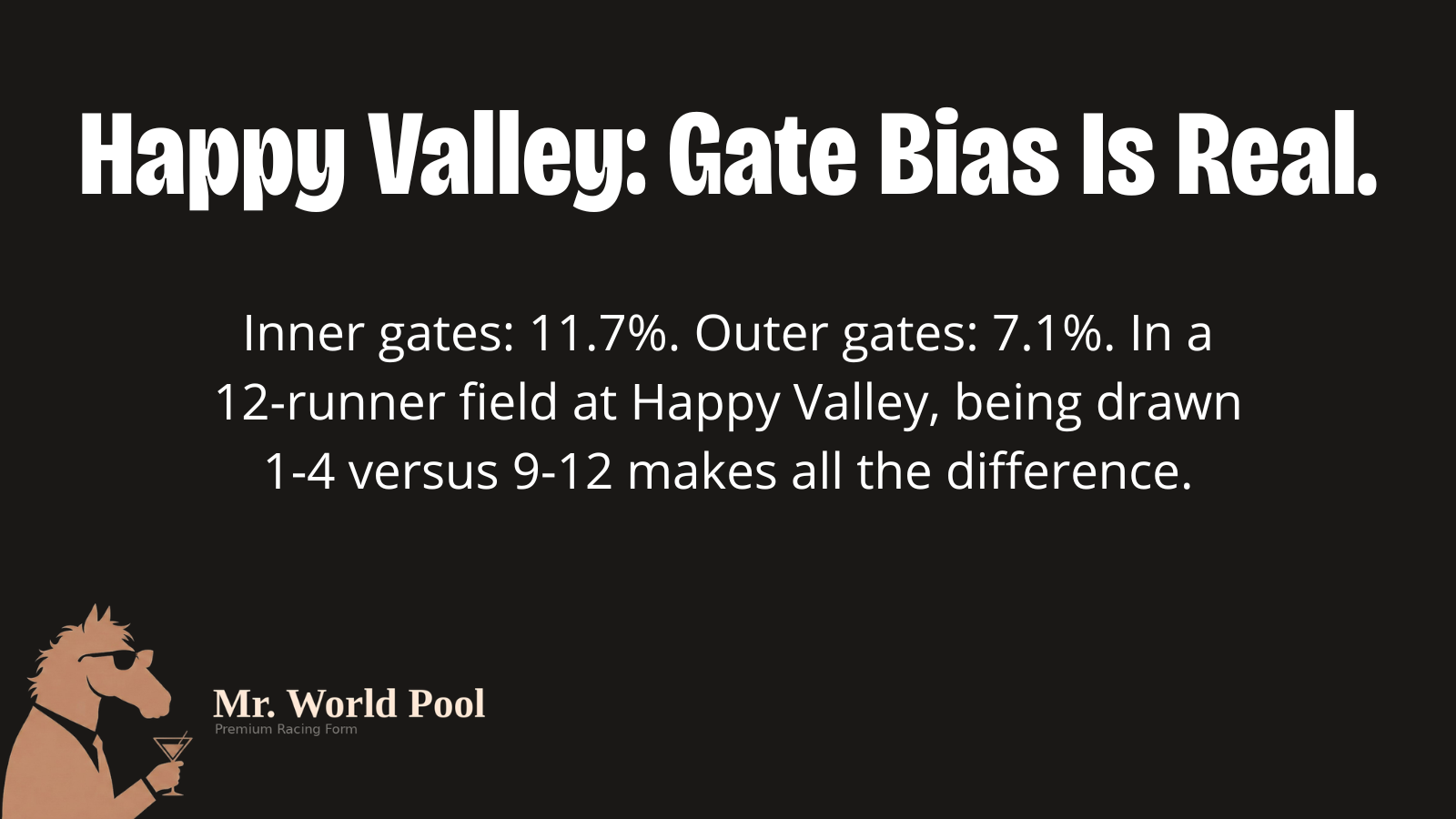
Happy Valley is the most striking case we have. Across 15,841 starts, the gap between inside and outside is about 7.5 points of win rate, and it stays at roughly that level whichever rail configuration is in use (A, B, C, C+3). Move the rail and the bias barely moves. Whatever is behind it, then, it is not simply where the rail sits on a given night; the most natural reading is that something fixed about the circuit is doing the work — though that, too, is an inference, not a measurement.
What makes Happy Valley genuinely one of one is the comparison. It is a famously tight circuit, and when we lined it up against Japanese (JRA) courses of a similar circumference — within 200 metres of it — those came in at only about +2 to +2.5 points to the inside. Happy Valley sits roughly three times higher. It is not "a tight turning track like the others," which is exactly why one generic draw adjustment, applied everywhere, will misprice it.
Field Size Changes the Picture
One pattern does repeat across courses, and it is a measured one: the bias tends to need a full field before it appears. Set it out as a threshold rather than a smooth slope.
- Happy Valley shows little bias until about 11 runners; above that it switches on.
- Sha Tin 2000m crosses over around 13 runners.
- Above their thresholds both settle near +7.5 points to the inside; below, both are roughly neutral.
The likely reason is intuitive enough — a big field packs runners tight into the first bend, so the inside saves the most ground exactly when ground is most contested, while a thin field never gets that crowded. But once again the threshold is the fact and the mechanism is the guess, and the practical reading needs only the fact: the same gate number means different things in a 14-runner field and an 8-runner one at the same course. Field size is part of the draw, not a footnote to it.
A Live Read: Sha Tin 1200m
To make it concrete with a current, verified split: Sha Tin over 1200m, gate 1 wins about 11.5% (n=1,665) while gate 13 wins about 4.6% (n=566). Same track, same trip, more than double the win rate for the rail gate. A fancied runner drawn 13 there is fighting the course before the gates open; an overlooked one drawn 1 has been handed an edge the table will show you and the market is often slow to price.
How to Use This Without Fooling Yourself
Two rules keep gate stats honest.
Sample size first. A gate with 40 starts behind it is a hint; one with 400, or 1,665 like Sha Tin's gate 1, is a fact. Every number above carries its sample for that reason. Treat anything thin with suspicion.
Bias is direction-independent, and it is not a betting system. A good gate lifts whoever draws it, favourite or longshot, and it is worth most when the horse holding it is one the market has not noticed. It rarely wins a race on its own.
You should not have to memorise any of this. It is exactly the sort of thing we try to surface in the form itself: every gate shows how it has actually performed at that course and distance, sample size attached, and each course carries a plain-language track description so you know what you are looking at before you read a single runner. The job is to adjust for the bias while you handicap — not to remember which 1000m straight has one and which does not.
If you want the geometry underneath the numbers — the ground-loss arithmetic and the run to the first turn — that is its own piece: Draw Bias and Ground Loss.
MWP computes how every gate has actually performed at each course and distance, with the sample size attached, and pairs it with a track description for every course. Pull up a real racecard and read the draw for yourself, or work through the gate stats in Do Your Homework, chapter 7.
Related: Draw bias and ground loss · Hong Kong racing form