Japanese Racing Form: The Middle-Distance Kingdom
More than half of all Japanese races fall in a narrow band around a mile, and that one fact reshapes how you read a JRA card.
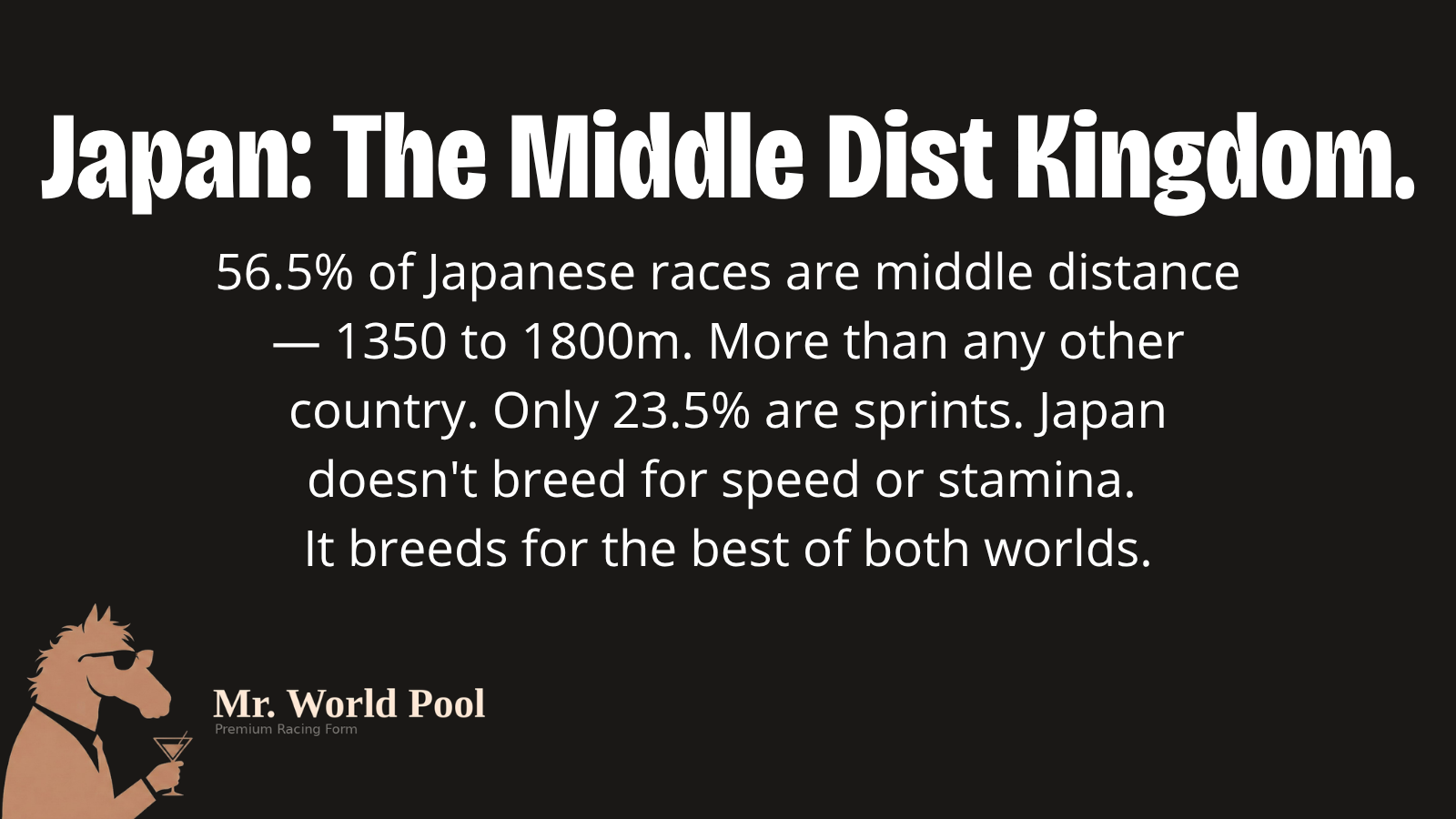
Start with the number that defines the jurisdiction: 56.5% of Japanese races are run between 1350m and 1800m. That is more middle-distance racing than any country we track. Australia crowds its programme into sprints, France leans long, and Japan sits squarely in the middle and stays there. If you want to read the JRA form, you read it for the type of horse that wins around a mile and a turn.
A Programme Written Around a Mile
The usual reading is that Japan breeds for the overlap rather than for pure speed or pure stamina, and then writes its race programme to match. Treat that as the explanation, not a proven fact. What is not in doubt is the shape of the calendar: the bulk of the opportunities sit in that 1350m to 1800m band, so the bulk of the population is built and campaigned for it.
That changes where you spend your study. In a sprint-heavy programme the first question is gate speed; in a staying one it is stamina and a late sectional over a mile and a half. In Japan the horse that matters most often is the one with enough speed to hold a position and enough stamina to finish off a true-run mile. The programme tells you which questions come up most, and here they cluster in the middle.
The practical consequence is that distance specialism reads a little differently than it does elsewhere. A horse that has only ever won at the extremes of the trip range is the exception on a Japanese card, not the norm. Most of the form you are reading was earned in the same broad middle band, which makes like-for-like comparison cleaner than in a jurisdiction that spreads its racing thinly across many distances.
Niigata's Straight: A Course That Isn't Neutral
Japan also offers one of the cleanest lessons anywhere in why a straight course is not automatically a fair one. Niigata has a 1000m straight sprint, and across roughly 2,300 starts it shows a genuine outer-rail bias: outside gates win about 9%, against roughly 2.5% for inside gates.
| Niigata 1000m straight | Win rate |
|---|---|
| Outer gates | ~9% |
| Inner gates | ~2.5% |
That is a large gap, and it runs against intuition. A straight track has no bend to lose ground on, so you might expect the draw to wash out. It does not. The usual explanation is surface: the outer part of the turf runs faster, and Japanese punters have a phrase for it, 外ラチ有利, the outer-rail advantage. Treat that as the working theory rather than settled mechanism. The lesson that survives whatever the cause is the one worth carrying to every track: a straight course is not a neutral course. Check the course-and-distance bias before you trust a draw, even when there is no turn in sight. The same discipline is set out in draw bias by track.
The Form Is Rich, and Mostly Public
The other thing that makes Japan a strong place to study is the data. JRA form is exceptionally detailed and largely available: sectional times, full replays, gear records. For a form student that is a deep feed, the kind that lets you check a running line against what actually happened rather than taking a comment line on trust.
Sectionals in particular reward the middle-distance focus. A mile run at a true pace is decided by how the field is travelling at the top of the straight and how much each horse has left, and sectional times let you see that instead of guessing it. Pair the splits with the replay and you can tell a horse that was flat-out throughout from one that quickened off a slow tempo, which is exactly the distinction that separates a real win from a flattering one. The method for turning that into a read is in pace handicapping.
How to Read a Japanese Card
- Expect the middle distances. More than half the programme sits between 1350m and 1800m, so most of the form was earned there. That makes distance comparison cleaner than in a country that spreads its racing wide.
- Don't trust a straight course to be neutral. Niigata's 1000m rewards the outer gates roughly three-to-one over the inner. Check the course-and-distance draw record before you back a horse off its gate.
- Use the sectionals. The data is there and it is good. A mile decided at the top of the straight is exactly the kind of race sectional times were made to explain.
- Read the figure, not the reputation. The craft is the same everywhere; Japan simply gives you a well-documented, middle-distance version of it to practise on.
If you have read our Hong Kong piece, the throughline will be familiar: the jurisdictions differ in shape, but the work of reading them does not. Japan's shape is the middle distance, and a programme built around a mile rewards the handicapper who studies it that way.
MWP reads the Japanese form for you: normalised ratings, gate stats and pace notes on every JRA runner. Open a real racecard and read the draw for yourself, or learn the method from the ground up in our free course, Do Your Homework.
Related: Draw bias by track · Pace handicapping · Hong Kong racing form