Meydan and UAE Racing Form: Lead or Lose on the Dirt
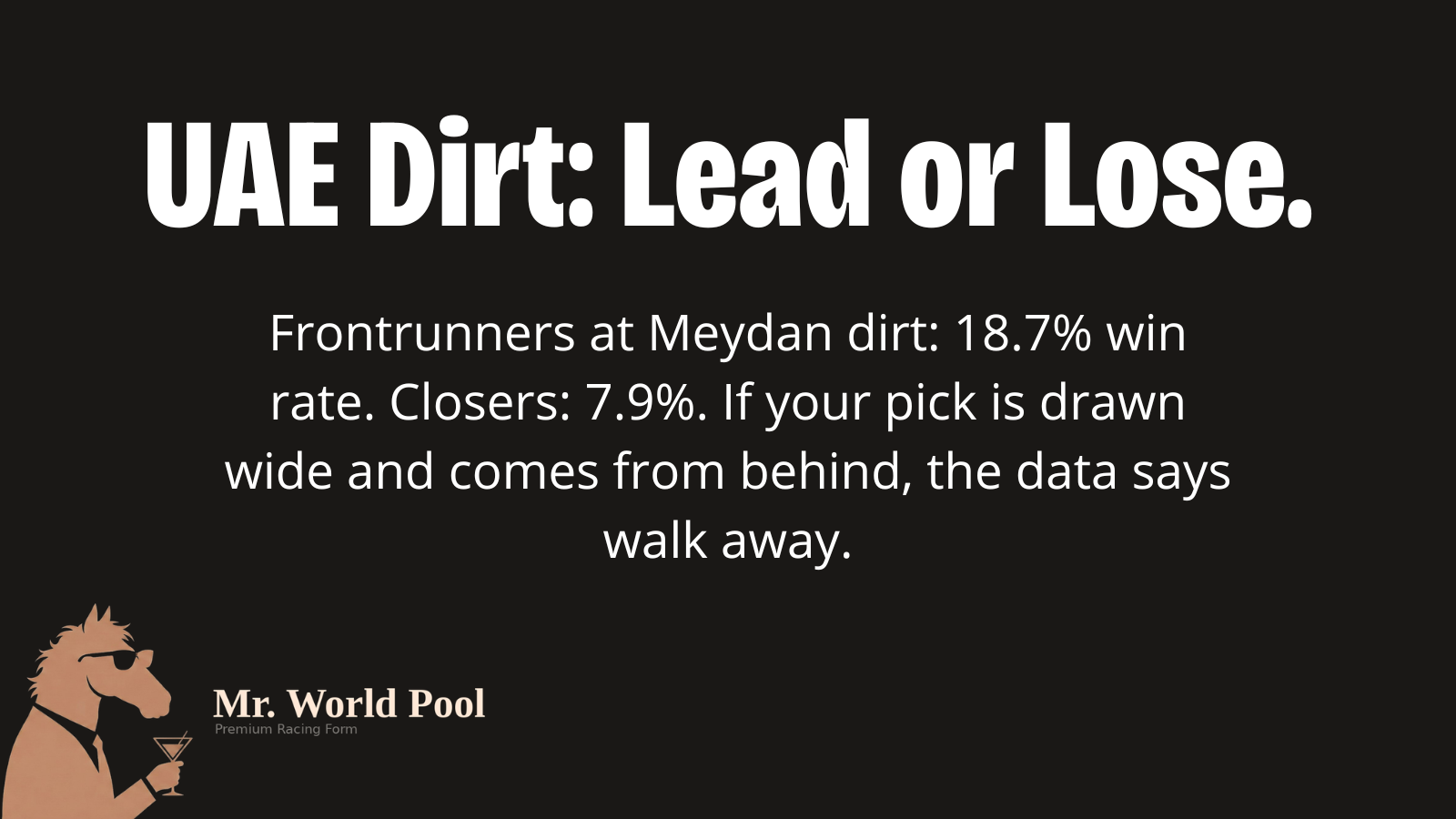
On Meydan's dirt, front-runners win about 18.7% and closers about 7.9% — the kickback sorts the field before the turn does.
On Meydan's dirt, front-runners win about 18.7% of the time and closers about 7.9%. That's more than two to one in favour of horses that get to the front and stay there. Before you back anything on UAE dirt, that single split should shape how you read the race.
Why the Dirt Rewards the Front
The usual explanation is kickback — sand and grit flung up by the runners ahead, which a horse sitting off the pace runs through the whole way. Whether that's the real driver or not, the split is clear: leaders win at roughly 18.7% on Meydan dirt against 7.9% for closers.
The draw compounds the same problem. A wide gate on dirt costs ground into the first turn and leaves a horse stranded outside the pace it wants to track. Pair that wide draw with a come-from-behind running style and the data says you've stacked two disadvantages on top of each other. Whatever the mechanism, the field tends to sort itself out before the turn does.
| Running style on Meydan dirt | Win rate |
|---|---|
| Front-runner | ~18.7% |
| Closer | ~7.9% |
The practical read: on dirt, find the likely leader, check the draw isn't fighting it, and be sceptical of a strong-finishing horse drawn wide. That last profile reads well on paper and underperforms on the track.
This isn't a guarantee. A lone front-runner with the rail and the only natural speed in the race is a very different proposition from one in a five-way pace battle that'll cook everyone up front. Count the speed before you decide the leader is safe. The bias tells you where to start looking, not who to back blind.
UAE Favourites Are the Most Fragile in the Major Markets
Now the part the market gets wrong. UAE favourites win only about 27% — the lowest strike rate of any major jurisdiction we track.
For context:
| Market | Favourite win rate |
|---|---|
| Australia | ~35% |
| Britain | ~34% |
| Germany | ~34% |
| UAE | ~27% |
That eight-point gap is large, and the usual story for it is the carnival structure. The UAE racing season is built on international shippers: horses arrive from Europe, America, Japan and Australia, many switching surface, many off a layoff, many running on form lines from races the local market can't easily compare. The plausible reading is that the crowd prices everyone off imperfect information, so a favourite assembled from a foreign form line is a shakier proposition than one bred and campaigned at home. That's a hypothesis for the gap, not a proven mechanism — but the gap itself is in the data.
Where favourites are fragile, the value hides in plain sight. A 27% favourite strike rate means roughly three in four go down, and the horses beating them are often priced as though the form transfer is cleaner than it is. You don't need an edge on every race. You need to notice when the market has trusted a shipper's home form more than it should.
This is the same structural point as our piece on false favourites and longshot bias: the favourite is just the crowd's best guess, and in the UAE the crowd is guessing across surfaces and continents.
The Booking Is a Form Line
One more UAE signal worth knowing. When a top international jockey takes a ride at the carnival, the booking itself tells you something.
Across the Middle East, William Buick wins close to 30%, about double a typical field-average strike rate. The likely reason is selection: a rider of that calibre tends to get put on horses connections already fancy, rather than no-hopers. On that reading the booking is a piece of form before the race is run — though the strike rate is the hard part, and the why is the story around it.
That doesn't mean back every Buick ride blind. Even a near-30% strike rate still loses most of the time, and the market knows his name and prices it in. It means treat a sharp international booking as a small piece of positive evidence, especially on a horse the rest of the form leaves ambiguous. When you can't separate two runners on the page, the connections' choice of rider is a tiebreaker worth weighing.
How to Read a UAE Card
Put the three together and a method falls out:
- Find the pace. On dirt, the front end wins. Identify the likely leader and check whether anything will press it.
- Read the draw against the style. A wide-drawn closer on dirt is fighting the track. Downgrade it. See draw bias and ground loss for why the gate matters most into the first turn.
- Distrust the favourite a little more than usual. A 27% strike rate means the market is wrong about its top pick three times in four. Ask what surface and form line the price is built on.
- Read the bookings. A top international on a hard-to-read horse is quiet evidence the stable fancies it.
The UAE is a value market precisely because it's hard to read. International form, surface switches and carnival noise reprice everyone, and a crowd guessing across continents leaves gaps. The work is in knowing where those gaps sit.
MWP normalises the form for every Meydan runner — ratings on one scale, gate stats with sample sizes, pace and trip notes — so a shipper's home form lines up against the locals. Open a real racecard and read the draw for yourself, or learn the method from the ground up in our free course, Do Your Homework.
Related: Draw bias and ground loss · False favourites and longshot bias