Exotic Betting Strategy: Why They Pay, and How to Build the Ticket
Exotics look like sucker bets with huge takeouts. For a skilled, disciplined player the maths runs the other way.
Exotic bets — Pick 4s, Pick 6s, trifectas, the Scandinavian V75 — have a reputation as lottery tickets: huge takeouts, brutal odds, money pits for dreamers. For most people who play them, that reputation is earned. But for a genuinely skilled, disciplined handicapper the maths points the other way, and it points hard. This article explains why, with the numbers, and then how to actually build a ticket so the edge reaches your pocket.
The Two Things That Compound
When you string several races together in one bet, two quantities compound at once.
Variance compounds. You need every leg to win, so the chance of collecting drops fast and the swings get violent. This is real and it's why most people can't stomach exotics. No argument there.
But edge compounds too. If you are genuinely better than the crowd on each leg, that per-race advantage multiplies across the legs in your favour. A 10% per-leg edge across four races compounds to roughly 1.10⁴, about a 46% edge on the combined bet. The same multiplication that punishes a delusion rewards a real skill.
That part is true of any multi-leg bet anywhere. What makes racing exotics special is the second ingredient.
Takeout Charged Once, Not Per Leg
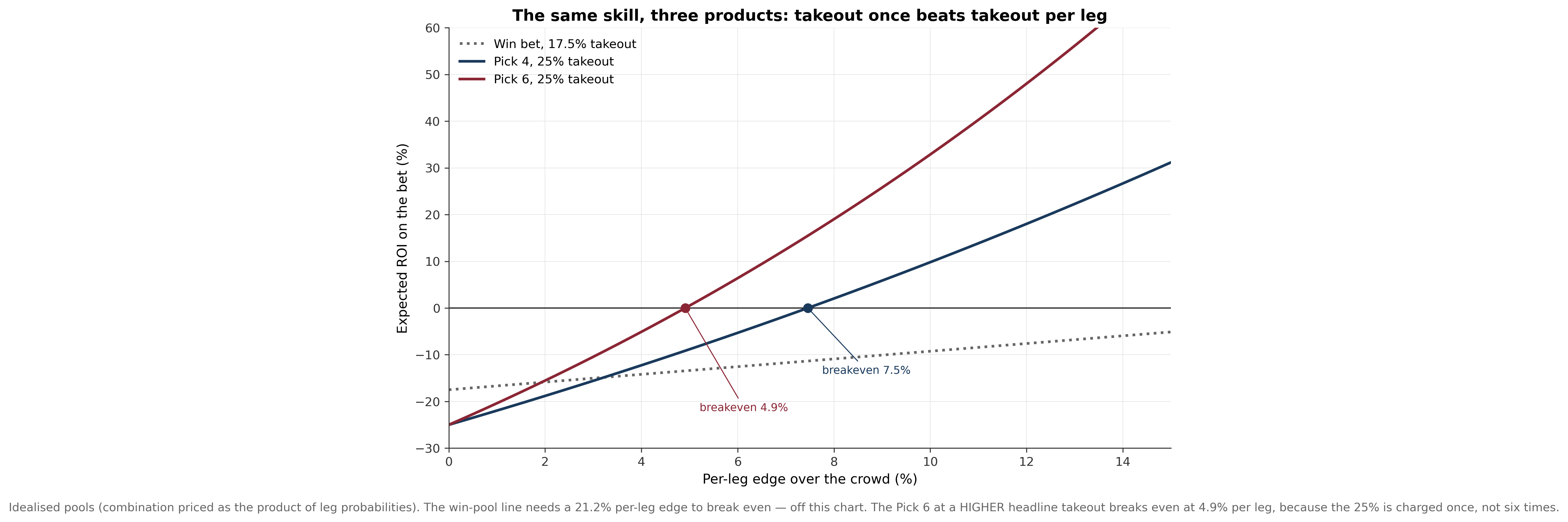
Here is the structural gift. In a multi-leg pool, the takeout is deducted once, on the combined bet, no matter how many races it spans. Bet the same races individually and you'd pay the takeout every single time. (The full comparison is in tote vs fixed odds: how takeout really works.)
Put numbers on it:
| Bet type | Headline takeout | Effective cost per leg | Break-even per-leg edge |
|---|---|---|---|
| Win bet | 17.5% | 17.5% | ~21.2% |
| Pick 4 | 25% (charged once) | ~6.9% | ~7.5% |
| Pick 6 | 25% (charged once) | ~4.7% | ~4.9% |
Read that again. The Pick 6, with the higher sticker takeout, asks for the smallest per-race skill to turn a profit, because the takeout is spread across six legs instead of charged on each. The deepest, most intimidating products in racing are exactly where moderate genuine skill first becomes money.
A Worked Example
Suppose you really are 10% better than the crowd per race. Strong, but attainable for a specialist in the right pond.
- On win bets: 1.10 × 0.825 − 1 = −9.3%. You're a demonstrably good handicapper, and you're still losing nine cents on the dollar to the takeout.
- In a Pick 4 (25% takeout): 1.10⁴ × 0.75 − 1 = +9.8%.
- In a Pick 6 (25% takeout): 1.10⁶ × 0.75 − 1 = +32.9%.
Same skill. Three completely different verdicts. The win bettor quits, convinced they have no edge. The exotic bettor, with identical ability, is running a strongly profitable operation.
The Jackpot Bonus
There's one more structural quirk that occasionally flips the takeout negative. When a multi-leg pool isn't hit, the prize money rolls forward as a carryover. On a mandatory-payout day, that carried-over money has to be distributed: money the day's bettors didn't stake.
Picture a pool with 300,000 carried over into a sequence that attracts 1,000,000 of fresh turnover at 25% takeout. The players stake 1,000,000; the pool pays out 0.75 × 1,000,000 + 300,000 = 1,050,000. The crowd, collectively, gets back more than it put in: a +5% aggregate return before any skill. It's the one situation in betting where the structural tax works for you. Serious exotic players plan their calendars around carryovers for exactly this reason.
Now Build the Ticket: Classify Every Runner A / B / C / X
Knowing exotics can pay is half the job. The bet type you choose, and how you construct it, decides how much of that edge actually reaches you. Before building any ticket, sort every horse in every leg:
- A — your strongest opinions: the likely winner, or a horse priced far above its real chance. A 12/1 shot you rate a genuine 15% is an A.
- B — live contenders, fairly priced, need some things to go right.
- C — longshot savers; need everything to break, but the price justifies a little insurance.
- X — throw-outs. No chance in your view. Not on any ticket, at any price.
Bet weight should be proportional to confidence and value, never spread equally. And note that the favourite and a juicy overlay can both be A's; you weight toward the value one, you don't throw the favourite out to look clever.
Single Where You're Strong, Spread Where You're Weak — and Never Box
This is the one principle that carries most of the value, and it's counterintuitive. In multi-race pools, single your strong A-horse legs to save money, and spread the legs where you genuinely can't separate four or five horses. Most people do the opposite — they hedge their best opinions and skimp on the races that actually need coverage.
A professional exotic isn't one ticket. It's several at different stakes. On a £48 Pick 4 budget, for example: a core A×A×A×A layer (£24), a spread layer covering one B in your weakest leg (£12), and a saver with C's where a bomb pays huge (£12). You buy the most coverage where you're least sure, and concentrate money where you're most sure.
And never box. A box assumes every combination of your selections is equally likely: A-over-B exactly as probable as B-over-A. You don't believe that, so don't bet it. Weight to your actual opinion: more on A-over-B, a saver on A-over-C, a little insurance on B-over-A. Boxing is paying full price to bet against your own read.
The Honest Warnings
This is not a free lunch, and three caveats keep it straight:
- The per-leg edge has to be real. Compounding multiplies a delusion as eagerly as a skill. A 10% edge you only think you have becomes a 33% loss you definitely will have. Prove your edge on cheap win bets first — track your closing line value — before scaling into the products that magnify it.
- The variance is genuinely large. You'll go long stretches without collecting. That demands bankroll discipline and a temperament most people don't have — likely part of why the competition in exotics tends to be thinner than the prize pools suggest.
- Ticket construction is its own skill. Reading the race right and building the ticket right are separate skills, and the second is where the money leaks. A winning exotic can even pay less than a simple win bet would have. And a clean self-check sits inside that: if you need five or six horses in a single leg to feel safe, you don't have an opinion on that leg. You have confusion, and the move is to pass the race.
Handicap the legs first. MWP gives you ratings, pace and gate data across the multi-race sequences on the world's big pools, so your A/B/C/X classification rests on real form, not a hunch. Open a racecard, or learn ticket construction in Do Your Homework, chapter 13.
Related: Tote vs fixed odds: how takeout works · Pace handicapping