Closing Line Value: The Honest Test of Whether You're Any Good
Win rate and P&L stay noisy for hundreds of bets. Closing line value tells you whether you have an edge in dozens.
You can bet for a year, finish in profit, and still have no idea whether you are skilled or lucky. Profit is a slow, noisy signal — it can flatter a losing method for months and bury a winning one just as long. Closing line value is the fix. It is the fastest reliable measure of betting skill that exists, and almost no recreational bettor tracks it.
This article explains what CLV is, why it works, and how to actually use it.
What CLV is
The closing line is the final price on a runner just before the off. In any liquid market, it is the sharpest public estimate of true probability there is — the usual explanation is that by then all the information and all the money have arrived, though what matters in practice is the measured efficiency of the closing price, not the story for it.
Closing line value is the gap between the price you took and that closing price. Back a horse at 5.0 that closes at 4.0 and you have positive CLV: you got a bigger price than the market's final, best estimate. Take 4.0 on one that closes at 5.0 and your CLV is negative.
That's it. CLV measures, bet by bet, whether you are consistently buying at prices the market later agrees were too big. Do that repeatedly and the conclusion is unavoidable: you are pricing horses more accurately than the market is, finding the same mistakes the market eventually corrects, just finding them first. That's exactly what an edge is.
Why it beats profit as a signal
Here is the part worth sitting with, because it's backed by simulation rather than assertion.
Take a bettor with a genuine, modest 4% edge and simulate thousands of betting careers. After 300 bets, nine out of ten of them already show an average CLV between 3.5% and 4.5%, and not one shows negative CLV. The signal has arrived. You can see the skill clearly.
Now look at the same bettors' profit over the same 300 bets. The middle ninety percent are spread from roughly −6% to +14% return on investment. About a quarter of these genuinely skilled bettors are losing money. The profit number is still almost pure noise.
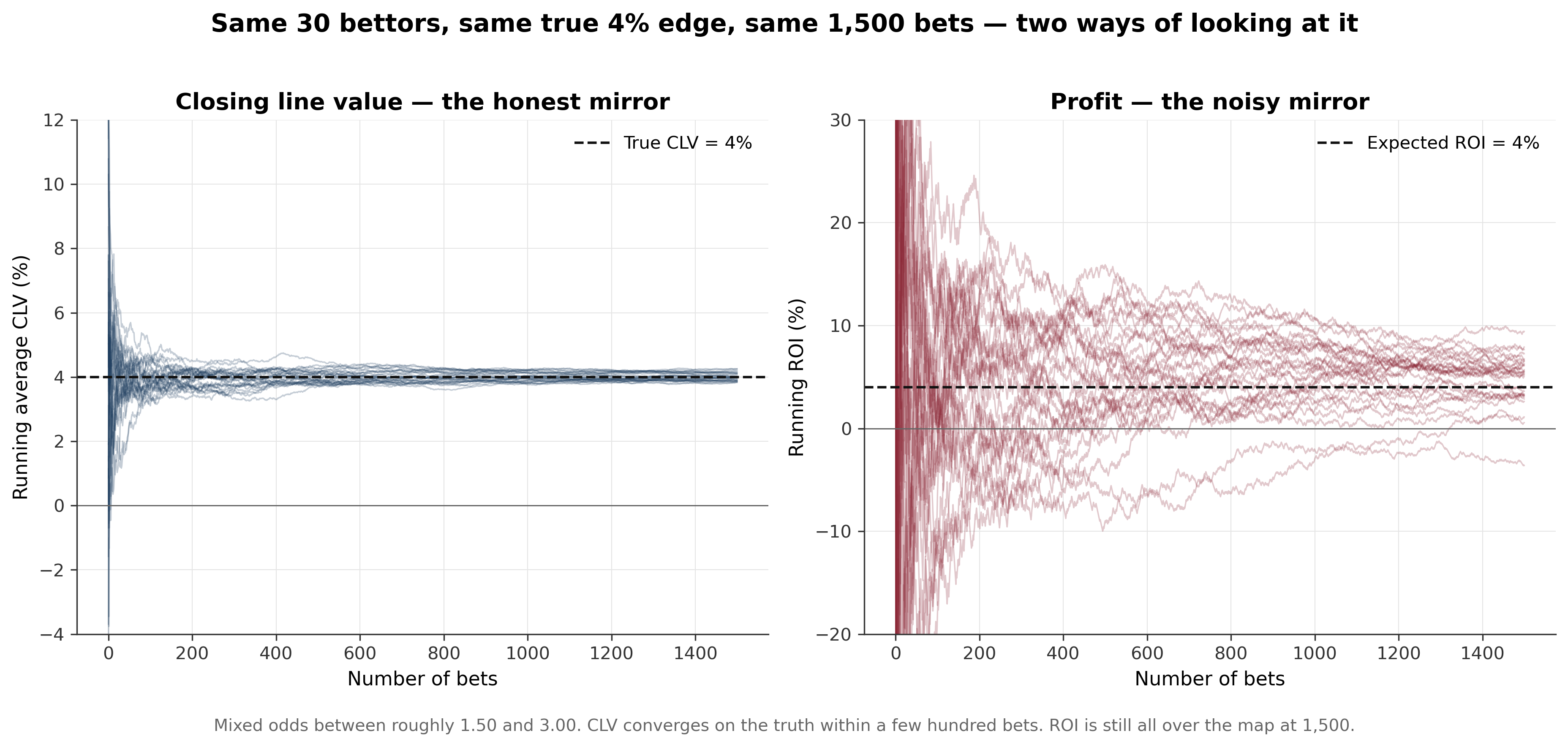
Push it out to 1,500 bets and profit is still scattered, with the occasional good bettor underwater. CLV stabilised five times faster. That is the whole case: CLV converges in hundreds of bets; profit takes thousands. Whether a bet won or lost is one noisy data point; whether you beat the closing line is a clean signal on every bet, win or lose. If you want to know whether you're good before a decade has passed, CLV is how.
The discipline it enforces
Tracking CLV changes how you bet in a useful way. It rewards betting early, when your own line spots a price before the market moves to it, and it punishes betting late, into prices the market has already corrected. It also kills a comforting illusion, the winning bet you took at a terrible price. The horse won, the ticket cashed, and your CLV on it was negative, which tells you the truth the result hid: you got lucky, and repeated, that bet loses. That's an uncomfortable thing to see in writing. It's also the fastest way to get better.
Your bookmaker already grades you on it
There's a second reason to care, and it explains a frustration many winning bettors run into. Soft bookmakers are widely understood to use closing line value to identify sharp customers, and then restrict them, rather than waiting to lose money to you. A few hundred bets of consistently positive CLV is often enough to get an account cut to small stakes, long before the profit shows up in your balance. The apparent logic is that CLV is a cleaner skill signal than their own short-term P&L against you — but the practical takeaway holds whatever the books' exact reasoning: positive CLV gets you noticed.
If your opponents grade you on CLV, you should grade yourself the same way. It is the most reliable mirror you have, and unlike your bank balance, it doesn't lie to you for a year at a time.
For racing and pool bettors: A/E
CLV is built for fixed-odds markets. In parimutuel pools there's no closing line to beat in the same way, and raw ROI is even more misleading there, because it tangles your skill up with the takeout. The equivalent tool is A/E: actual winners divided by expected winners. "Expected" is the sum of your selections' fair probabilities implied by the SP. Back 200 horses whose SP-fair probabilities add up to 50, and if 55 of them win, your A/E is 1.10 — you're finding winners 10% faster than the market's own prices predict, with the takeout stripped out by construction.
Why this matters so much: a bettor who is genuinely 8% better than the crowd can show a negative win-pool ROI of around −11%, purely because of the takeout, and wrongly conclude they have no edge. Their A/E, meanwhile, sits clearly above 1.0 and converges far faster than ROI, telling them the truth the profit figure hides. And that truth has teeth: the same skill that loses on win bets can be strongly profitable in exotics, where the effective takeout is far lower. A/E is to pool betting what CLV is to fixed odds: the measure that isolates skill from the cost structure and converges fast enough to act on.
One caveat
CLV is the best single proxy for edge, not a guarantee of profit. You still pay the takeout, so you need enough closing-line value to clear it, and CLV is only meaningful in markets with an efficient, well-formed closing price — deep pools and exchanges, not thin and chaotic ones. Used inside those limits, it's the most reliable early-warning system a bettor has. Track it on every bet, watch the average, and trust it over your short-term P&L.
The catch: you have to track it
CLV only works if you record it: the price you took, and the closing price (or SP), on every single bet. Logging the taken price is easy; going back to capture the close and compute the percentage, bet after bet, is the chore that quietly stops happening in a busy week. This is precisely the kind of measurement worth automating.
The MWP bet tracker logs the closing price against every bet and reports your average CLV (and A/E in pools) over time, so you get the early-warning signal without the manual work — see the bet tracker. Start with the case for tracking at all in how to track your bets.
Related: Betting calibration: are your probabilities any good? · Value betting in horse racing