Tote vs Fixed Odds: How Takeout Really Works
Parimutuel or fixed odds? Two mathematically different games — and the headline takeout number is not the one that matters.
Two systems dominate horse-race betting, and they are mathematically different games. Understand how each one charges you, and a lot of strategy follows automatically. This guide explains parimutuel (tote) betting versus fixed odds, what takeout and overround actually are, and why the headline takeout number is not the one that matters.
Fixed odds: betting against a price
In fixed-odds betting you take a price and it's locked in. If you back a horse at 4.0, you get 4.0 whatever happens to the market afterward.
The bookmaker's edge is the overround — the margin built into the prices. Add up the implied probabilities of every runner (one divided by each price) and the total comes to more than 100%. That excess is the margin. A sharp book might run a few percent; a soft, recreational-facing book a great deal more, especially on exotic and multiple bets.
The key features: you know your price when you bet, sharp books offer the tightest margins, and winning customers eventually get their accounts restricted. You're betting against a business that prices to make money whatever wins.
Parimutuel: betting against the crowd
In tote betting there's no bookmaker at all. Every stake goes into a pool, the operator removes a fixed percentage — the takeout — and the winners share what's left in proportion to their stakes.
Three consequences follow, and they change how you play:
- You don't know your final price when you bet. The displayed odds are provisional; late money moves the dividend, including your own.
- Your own bet moves the price against you, which matters in small pools.
- Your opponent is the crowd, not a model. You're not trying to out-think a sharp trading desk — you're trying to be more accurate than the other bettors, net of takeout. In many pools that's a softer opponent.
Takeouts run from around 15% to 30% depending on the jurisdiction and the bet type. On the surface that looks far worse than a fixed-odds margin. Often it isn't, and here's why.
Why the headline takeout misleads
The single most useful fact in pool betting is this: on a multi-leg bet, the takeout is charged once on the combined bet, not once per leg.
Compare two ways of betting four races. Roll a win bet through all four — bet the winnings of race one onto race two, and so on — and at a 17.5% win takeout you pay that takeout four times. The total tax works out to about 54% of your money.
Now bet the same four races as a single Pick 4 at a higher-looking 25% takeout. Because the 25% is charged only once on the combined bet, the effective cost is about 6.9% per race. The exotic, with the scarier headline number, is dramatically cheaper for holding a multi-race opinion.
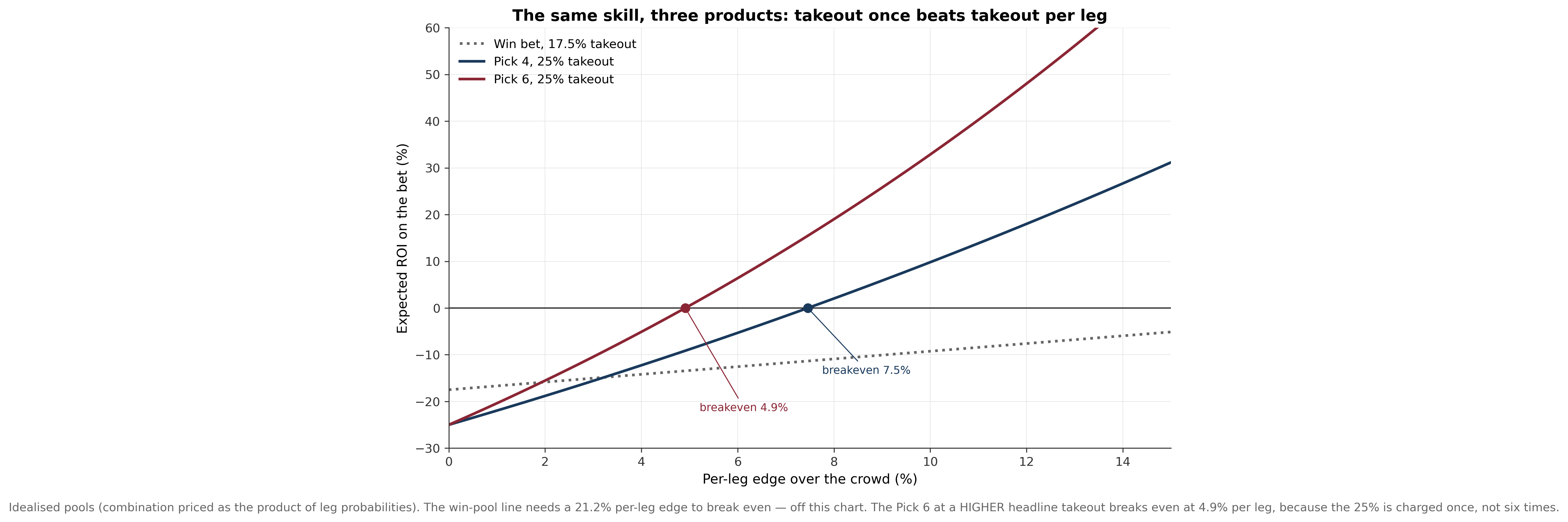
This is counterintuitive enough that most bettors never grasp it, which is likely a large part of why it stays exploitable. We work the numbers fully in why exotic bets can be profitable.
Which is better for a value bettor?
It depends on what you're good at and where you can get your money on.
Fixed odds suits you when you can identify value against a price and act on it — especially early, before sharp markets tighten. The drawback is account restriction once you win consistently.
Parimutuel suits patient specialists, particularly in exotics, for three structural reasons: the crowd is often a softer opponent than a sharp book; the takeout on multi-leg bets is charged once, not per leg; and no one bans you from a pool for winning. The drawbacks are takeout on straight bets, uncertain final prices, and high variance in the exotics.
For many serious racing bettors the answer isn't either/or. Fixed odds for specific value plays where you can beat a price; pools — especially exotics and jackpot bets, and the deep commingled World Pool — where your edge compounds across legs against a beatable crowd.
The thing both systems have in common
Whichever you're betting, you start behind. The margin or the takeout is the price of admission, and only genuine value — prices or pool positions bigger than the true chance by more than that cost — gets you in front. That's true at a 2% sharp overround and a 25% exotic takeout alike; only the size of the hill changes.
So the work is the same in both worlds: estimate the true probability more accurately than the market, and bet only when the price is bigger than the truth. The system you choose decides the size of the toll. Your handicapping decides whether you clear it.
Find value across both worlds. MWP gives you the deep, consistent form data that serious pool and fixed-odds players need across international racing. Open a real racecard, or learn to price a race free in Do Your Homework, chapter 12.
Related: Why exotic bets can be profitable · What is World Pool?