Value Betting in Horse Racing, Explained Properly
Picking winners and making money are different skills — what value and expected value really mean, and why the likely winner is often a losing bet.
Most people who bet on horses are trying to pick winners. The small minority who make it pay are doing something different and harder: they are finding prices that are too big for the chance. That is value betting, and it is the only edge that survives over the long run. This guide explains what value really means, why it feels so counterintuitive, and how to know whether you actually have it.
The Definition
A bet has value when the true probability of the outcome is higher than the probability implied by the odds.
Convert any price to its implied probability by dividing one by the decimal odds. A horse at 5.0 implies a 20% chance (1 ÷ 5.0). The only question that matters is whether the horse's true chance is bigger than 20%. If you judge it a 25% chance, the price is an overlay and the bet has value. If you judge it 15%, it's an underlay, and backing it loses money over time no matter how often it happens to win.
Notice what this does not depend on: whether the horse is likely to win. A 5.0 shot you rate at 25% is a value bet and will still lose three times out of four. A 1.5 favourite you rate too short is a bad bet even though it wins most of the time. Value lives in the gap between price and truth, not in the result.
The Maths Nobody Wants to Hear
A horse with a genuine 60% chance is a losing bet at 1.5 — because 1.5 implies the horse should win 67% of the time. A horse with a genuine 10% chance is a winning bet at 15.0 — because that price implies just 6.7%. The first horse usually wins and costs you money. The second usually loses and makes you money.
Value investors have run on this distinction for a century. Warren Buffett, crediting his teacher Ben Graham, put it in five words: price is what you pay, value is what you get. Swap the stock for a horse and nothing changes. The question is never "will this horse win?" It's "is this horse correctly priced?" The first is gambling. The second is investing.
Expected Value, in One Line
You can put a number on it. Expected value is:
(your probability × decimal odds) − 1
- A 25% chance at 5.00 (4/1): (0.25 × 5.00) − 1 = +0.25. A bet worth making.
- The same 25% chance at 3.50: (0.25 × 3.50) − 1 = −0.125. A donation.
Same horse, same chance, different price. One is a professional bet, the other a slow leak. Everything else in serious form study exists to get your probability estimate honest enough to trust this calculation.
Building Your Own Line
The discipline that follows is simple to state and hard to keep:
- Handicap the race and estimate each contender's real win chance.
- Convert those chances to fair odds (decimal odds = 1 ÷ probability — 25% is 4.00, 10% is 10.00).
- Compare your line with the market.
- Bet only when the market's price is meaningfully bigger than yours.
The crucial habit: build your line before you look at the tote. Look at the market first and you anchor to its opinion instead of forming your own. You stop pricing the race and start explaining the favourite. What you're betting on is the gap between your line and the market — not the horse most likely to win.
Why Picking Winners Isn't Enough
When someone says "I really fancy this one," they usually mean they think it's the most likely winner. So does the market — that's why it's favourite. Agreeing with the market is not an edge.
And it loses because of the takeout and the overround — the margin built into every market. In a tote pool, 15–30% is removed before anyone is paid. At a bookmaker, the prices add up to more than 100%. Either way you start every bet behind, and only genuine value — prices bigger than the truth by more than that margin — climbs back in front.
One caveat keeps this from becoming a sales pitch. Beating the crowd's judgement is not the same as beating the price. Our top-rated horse beats the market's margin-free estimate by around 6% (8% at short prices), which is genuinely hard to do — yet a flat bet on it still loses, because the takeout sits on top. That's why value betting is a game of selection and patience: skip the races where you have no edge, bet only the clear overlays, and play into the deepest, lowest-margin pool you can reach.
Where Value Comes From in Racing
Racing offers more mispricing than almost any other betting market, probably because so much of what decides a race isn't in the bare figures:
- A horse whose last run looked worse than it was — blocked, wide, into a bias — tends to be underbet by a crowd reading the finishing position.
- A false favourite, short because of name or a last-time flash rather than true chance, inflates the value of everything else in the race.
- A trainer or going angle the wider market hasn't priced.
Reading those situations rests on reading the form and the ratings for what they leave out, not just what they show.
The Hard Part: Knowing Whether You Actually Have Value
Here's the uncomfortable truth. You can believe a price is value and simply be wrong — your probability estimate can be off, and for a long time the results won't tell you which. A run of winners can hide a losing method; a run of losers can hide a winning one.
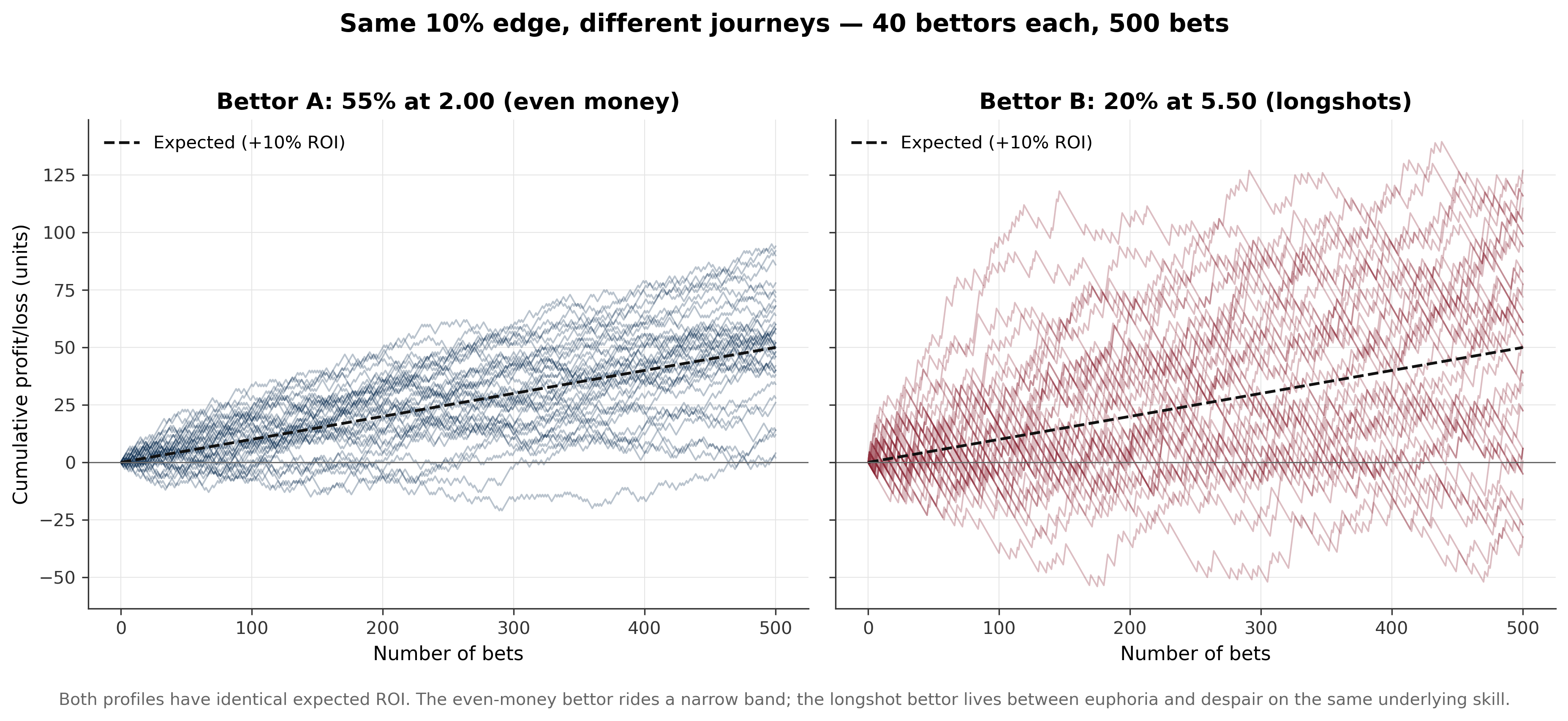
So how do serious bettors check? They measure closing line value — whether the prices they took beat the market's final, sharpest price. It's the closest thing to a fast-converging test of whether your value is real. And the discipline underneath it all — sizing your bets so variance can't ruin you before the edge pays — is bankroll management and staking. Value tells you what to bet. Staking decides whether you survive long enough to collect.
Price a race yourself. MWP gives you a performance rating and an expected rating on every runner, then lets you turn your read into a fair-odds line — try a real racecard, or learn the full method free in Do Your Homework, chapter 12.