Bankroll Management and Staking: The Half of Betting Nobody Wants to Learn
Most bettors with a real edge still go broke because they stake it wrong. How to size bets so variance can't ruin you, the Kelly formula, and why fractional Kelly wins.
Finding value is hard. Staking it correctly is at least as hard, and far less glamorous, which is why most bettors ignore it and most bettors lose. Here is the uncomfortable truth this article is built on: a real edge, staked badly, still goes broke. Variance doesn't care that you were right about the prices. This guide covers how to size bets so it can't end you before your edge pays out.
Why a Real Edge Isn't Enough
Run a simulation: thousands of bettors, each with a genuine 5% edge, a real and professional-grade advantage, all betting at even money. The only thing that varies is how much they stake.
Stake a large flat percentage of bankroll on every bet and a meaningful share of them watch the bankroll halve at some point, and some go broke entirely. Every one of these bettors had a real edge. The skill was never the problem. The stake size was.
Drop to 2% proportional stakes and the deep drawdowns largely disappear. Go smaller still, to roughly quarter-Kelly, and the swings shrink again while most of the growth stays intact. Same edge, wildly different survival, decided entirely by bet size.
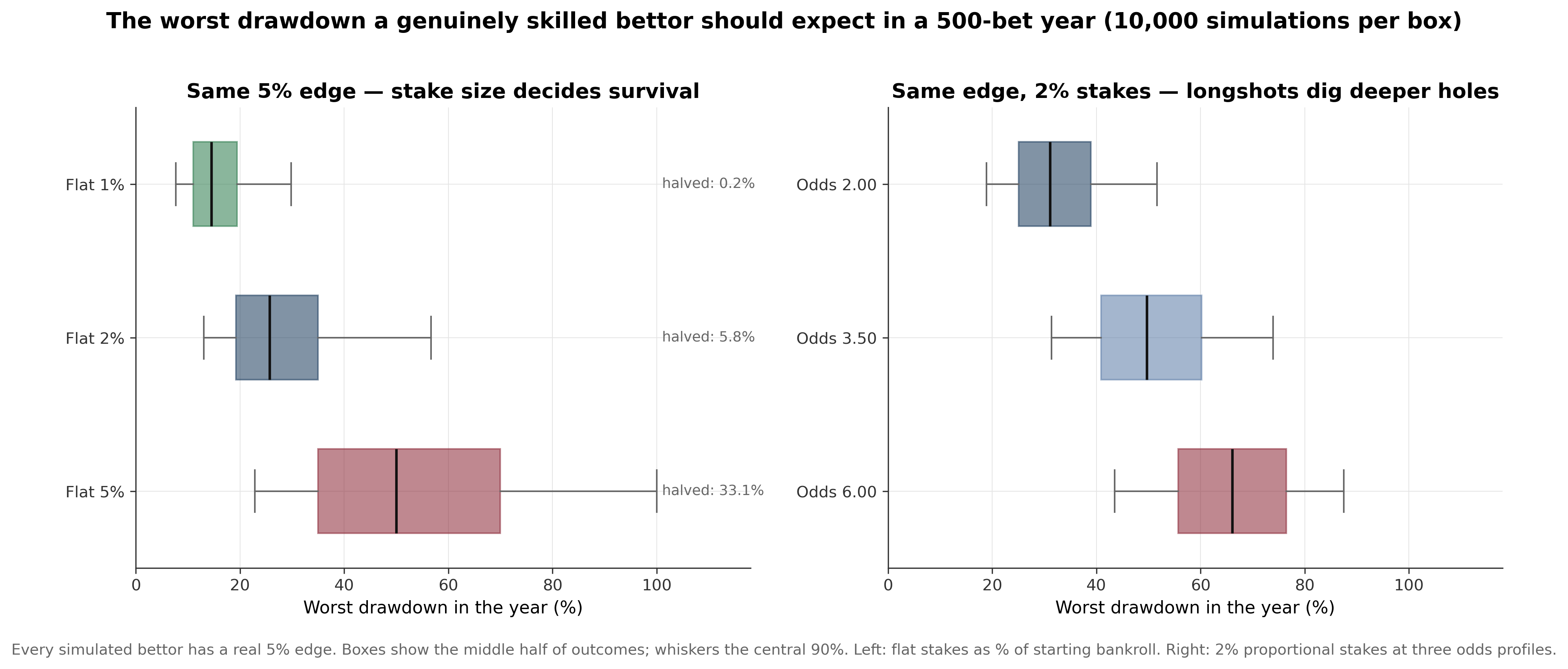
The lesson: size your bets by how bad the downswing can get, not by how confident you feel. Amateurs ask "how big is my edge, so how much should I bet?" Professionals ask "how deep can the bad run go, and can I survive it?"
A 5% edge at even money is the setup behind the chart above: flat staking a large slice of the bankroll courts ruin, 2% proportional staking tames the drawdowns, and quarter-Kelly tames them further still.
The Bankroll Itself
Before sizing, the bankroll has to be real:
- It's money you can lose completely without changing your life. Not "lose with a wince", but lose without it touching your rent, your relationships, or your sleep.
- It's separated from your everyday money, in its own account, with a starting balance you wrote down and dated.
- It's large relative to your bets, typically fifty to a hundred times your standard stake. If that feels like too much money for the stakes you have in mind, that's useful information: your stakes are too big for your bankroll.
Flat, Proportional, Kelly
Three ways to size:
Flat — the same amount every bet. Simple, but it never adapts: bets stay too small after wins and dangerously large after losses, and a long enough losing run can take a flat staker to zero.
Proportional — a fixed percentage of your current bankroll. Bets shrink after losses and grow after wins, which is the correct direction, and crucially, a proportional staker can't be wiped out by any finite losing streak.
Kelly — proportional staking where the percentage scales with the edge and the odds of each specific bet. Bigger edges get more; longer odds get less. It's the mathematically correct refinement, and it's dangerous in exact proportion to how wrong your edge estimates are.
The Kelly Formula
Kelly gives the fraction of your bankroll to stake:
f = (p × o − 1) ÷ (o − 1)
where p is your estimated win probability and o the decimal odds.
Say you make a horse a 25% chance at 5.00. Then f = (0.25 × 5.00 − 1) ÷ (5.00 − 1) = 0.25 ÷ 4 = 6.25%. That's the full-Kelly stake, the bet size that maximises long-term growth if your probability is exactly right.
Why Fractional Kelly Wins
Your probability is never exactly right, and full Kelly is brutally sensitive to that. It assumes perfect accuracy, and when your estimates are even slightly off it produces stomach-churning drawdowns.
Simulate a bettor who thinks they have a 10% edge but really has 3%, staking on the belief. On full Kelly the median bankroll shrinks over a thousand bets, with a high chance of losing 80% or more: a real, positive edge, destroyed by overbetting an imagined one. The same bettor on quarter-Kelly stakes ends up far safer, because a quarter of the (wrong) stake sits much closer to the true safe level.
That's why almost every long-term winner stakes a fraction of Kelly, typically a quarter to a half. In the example above, quarter-Kelly is 6.25% ÷ 4 = 1.56%. You give up surprisingly little, keeping most of the growth rate at a fraction of the volatility, and you buy survival, gentler drawdowns, and tolerance for the errors you don't yet know you're making. The principles matter more than the exact formula: more on bigger edges, less at longer odds, the biggest bets reserved for a big edge at a short price, and nothing at all without an edge.
The Caps That Sit on Top
Even fractional Kelly needs guard rails:
- Single bet: cap at 2–3% of bankroll, even if Kelly says more.
- Daily exposure: 5–10% across all bets combined.
- Watch combined exposure: a win bet, an exacta and a multi-race ticket all keying one horse can quietly stack to 5% on a single result.
And two working rules the formula doesn't tell you. Set the fraction by how much you trust the estimate, not how much you fancy the horse: a shaky probability earns a smaller stake than one you've nailed. And when you hit a losing run you can't explain, cut the fraction and go hunting for the mistake. The bettors who survive shrink and audit; the ones who don't bet bigger to win it back.
The Drawdowns to Expect
Even staked conservatively, the swings are larger than intuition expects. A genuinely winning bettor on quarter-Kelly should expect a drawdown past 20% of their bankroll roughly every other year, with nothing wrong, purely as variance doing its work. If a 20% drawdown would make you abandon your method, your method is already broken, because that drawdown is coming whether your edge is real or not.
The defence is to decide your response before it happens: pre-set, mechanical stake reductions at fixed thresholds (pause and review at 20%, halve stakes at 30%, stop and re-evaluate at 40%), with strategy changes only on a scheduled review, never in the heat of a bad run.
The Hard Part Isn't the Maths
The formula is trivial. The probability you feed it is everything, and most people are overconfident, so their "25%" horses win more like 18%, which quietly turns a good staking plan into a slow bleed. That's why staking, value and self-measurement are one system: you need a fair line, you need to check your calibration, and you need a record to do both. Get the probability right and Kelly tells you the rest. Get it wrong and Kelly just helps you lose faster.
Skip the arithmetic. The MWP bet tracker has a built-in Kelly tab — feed it your probability and the available odds and it returns the full and fractional stake, leaving you only the part that's actually hard: an honest number. See the bet tracker. This is also one chapter of The Long Edge, a practitioner's manual on betting like the small minority who actually make it pay.
Related: Value betting in horse racing · Betting calibration · How to track your bets