How to Track Your Bets: The Highest-Return Habit in Betting
You remember the 16/1 winner and forget the twelve 4/1 losers — without a record you don't know if you're winning.
Ask a recreational bettor how they're doing and they'll tell you about the 16/1 winner. They won't mention the twelve 4/1 losers that paid for it, because they've forgotten them. That's not dishonesty — it's how memory works, and it's why, without a record, you genuinely do not know whether you are winning.
Keeping a betting record is the highest-return habit in betting, and the most widely skipped. Without one you have no feedback loop, and without a feedback loop you can't improve — you can only repeat yourself with growing confidence. This guide covers why it works, what to log, and how to turn a list of bets into something that actually changes how you bet.
The Brain Is Built to Mislead You Here
Human memory keeps the vivid and discards the routine. Wins are vivid. Near-misses are vivid. The steady drip of small losing bets is routine, so it evaporates. Layer on the stories we tell ourselves — "I was unlucky", "that one doesn't count", "I knew it would win" — and your mental P&L isn't just fuzzy, it's biased in the flattering direction.
A written record doesn't have feelings. It just adds up. Almost everyone who starts keeping one has the same reaction within a few weeks: "I was doing worse than I thought." That jolt is the point. It's the moment your betting switches from a story you tell yourself to data you can act on.
Friction: The Underrated Benefit
Here's the part nobody markets, because it sounds like a downside. Logging a bet adds a small amount of friction — a few seconds of writing down what you're about to do and why.
That friction is a feature. A surprising share of losing bets are the ones you'd never place if you had to justify them in writing first. "I've found no value in three races, but I want some action" doesn't survive contact with a tracker that asks for your estimated probability and your price. The act of recording the bet quietly kills the bets that shouldn't exist. For many bettors, that discipline alone is worth more than every angle in the form book.
What to Log
Two minutes per bet. Each field earns its keep later:
- Date and time — for spotting when your decisions degrade (late nights are a common leak).
- Sport / meeting and market — your main way to segment performance.
- Selection and event — enough to reconstruct the bet.
- Stake — in money and as a percentage of your bankroll at the time.
- Odds taken — decimal.
- Your estimated probability — written before the off. This is the field almost everyone skips, and the one that makes calibration possible.
- Confidence grade — A/B/C or 1–5, your read on how strong the bet was.
- Rationale — two or three plain sentences on why you bet.
- Closing price or SP — filled in after the off. This feeds CLV and A/E.
- Result and profit/loss.
- A one-line note after settlement on anything you learned.
If you must shrink it, fight hardest to keep the estimated probability and the rationale. The probability is your calibration data. The rationale is your defence against hindsight bias — six months later, the version of you reviewing the bet will be certain they "knew", and the note you wrote at the time is the only honest witness. One underrated extra: log the bets you considered and passed. Your "no" decisions are decisions too, and a record of near-bets tells you whether your filters are too loose or too tight.
Turn the Log into a Feedback Loop
Data you never read is a diary, not a tool. The value comes from review, on a cadence:
- Weekly (20 minutes): Did you follow your own process? Any rule-breaks, chases, or stakes outside plan? Not "did I win" — a week of results is noise.
- Monthly (an hour): Segment profit and CLV by sport, market, odds range, stake size, day and time. This is where leaks and strengths first show.
- Quarterly (half a day): The big picture. Is the strategy still right? This is where you're allowed to change beliefs — with a full quarter of data in front of you, not in the middle of a bad week.
Start every review by reading the previous one. Reading what you actually thought a month ago, against what happened, is the cheapest cure for hindsight bias ever invented.
Find Where Your Edge Actually Lives
The most valuable thing the monthly segmentation gives you isn't whether you're winning — it's where. A flat profit figure blends the markets you read well with the ones you don't. Break-even overall can easily mean strongly profitable on Hong Kong dirt and strongly negative on UK handicaps, the two cancelling out, and looking only at the total you'd keep funding the leak with the edge. Slice your results by jurisdiction, surface, bet type and price range, then do more of what works, stop doing what doesn't, and investigate the surprises (sometimes the segment you were proudest of is a loser). The bettor who knows where their edge lives, and bets accordingly, beats a more talented one who spreads thin across everything.
The Metrics That Matter
Two families, read in the right order:
- Process metrics converge fast and tell you if you're doing the right things: average CLV (or A/E in pools), share of bets beating the close, calibration, adherence to your staking plan.
- Outcome metrics converge slowly and tell you if it's paid yet: profit, ROI, strike rate, drawdown.
This ordering isn't a stylistic preference — it's how the maths behaves. Closing line value settles around its true level after a few hundred bets, while ROI is still scattered across a wide range at the same sample size, and stays scattered well past a thousand bets. Read the signal that has converged, not the one that hasn't.
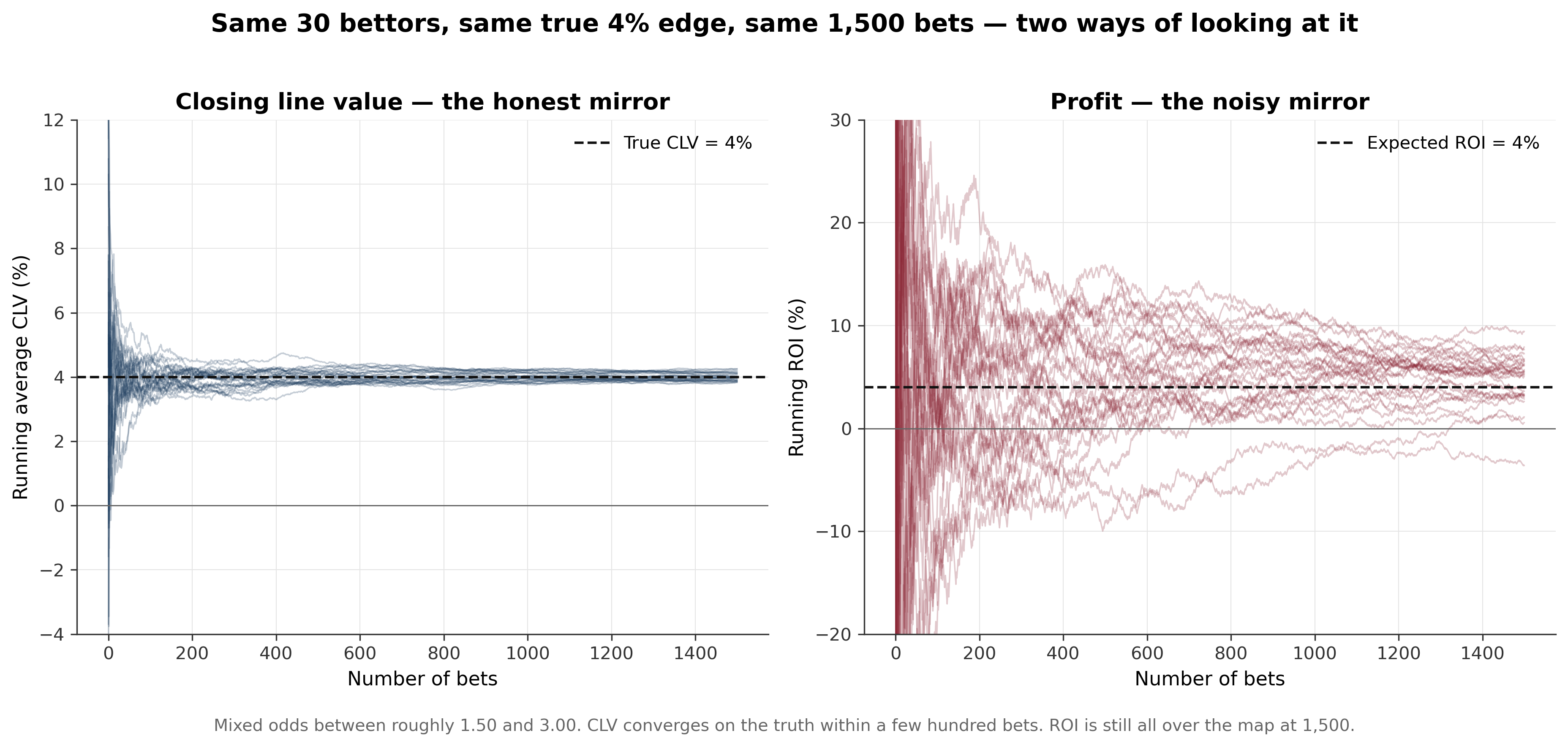
Positive CLV in a losing month is variance — keep going. Negative CLV in a winning month is borrowed money — fix something. Read the fast signals first.
Make It Stick
The reason most records die is friction: logging the bet is easy, but going back for the closing price and computing CLV, A/E and calibration across a busy week is exactly the chore that quietly stops happening. You don't need a tool — a disciplined spreadsheet does the job. You need a system. The chore you automate is the chore that actually gets done.
Make it frictionless enough that you'll actually do it. The MWP bet tracker takes the log structure above and produces the metrics automatically — a bet log feeding a P&L dashboard, a bankroll ledger, a Kelly staking calculator, and calibration and closing-line-value tabs that do the hard maths for you. See the bet tracker.
Related: Closing line value explained · Betting calibration · Bankroll management and staking